What Causes Panic Attacks and How Do We Stop Them?
What Causes Panic Attacks and How Do We Stop Them?
If you have ever experienced a panic attack, you will know just how terrifying it can be. The racing heart, the inability to breathe, the sense of impending doom, the feeling that something is catastrophically wrong with your body. Panic attacks can feel like a heart attack, a stroke, or a complete loss of control. And yet, once you understand what is actually happening during a panic attack, and crucially why it is happening, a clear path to stopping them for good begins to emerge.
This guide explains the science behind panic attacks, why they are not random or unpredictable, and what genuinely works to resolve them at their root.
Watch This Panic Attack Case Study Here - https://www.newcastle-hypnotherapy.com/post/overcoming-anxiety-panic-attacks-trauma-robs-story
What Is a Panic Attack?
A panic attack is a sudden, intense surge of fear or physical distress that peaks within minutes and triggers a cascade of overwhelming physical and psychological symptoms. These typically include:
Rapid or pounding heartbeat (palpitations)
Shortness of breath or feelings of suffocation
Chest tightness or pain
Dizziness, lightheadedness or feeling faint
Tingling or numbness in the hands, feet or face
Sweating, trembling or shaking
Nausea or stomach upset
A feeling of unreality or being detached from yourself (derealisation)
An overwhelming sense that something terrible is about to happen
Most panic attacks last between five and twenty minutes, though the aftermath, the exhaustion, the anxiety about having another one, can linger for hours or days.
Panic attacks can occur in specific situations, such as crowded places, social settings or while driving. They can also occur seemingly out of nowhere, even during sleep. Both types have the same underlying cause.
What Causes Panic Attacks? The Science Explained
Understanding what causes panic attacks is the first step towards stopping them. And the science here is both clear and genuinely illuminating.
The Amygdala and the Threat Response
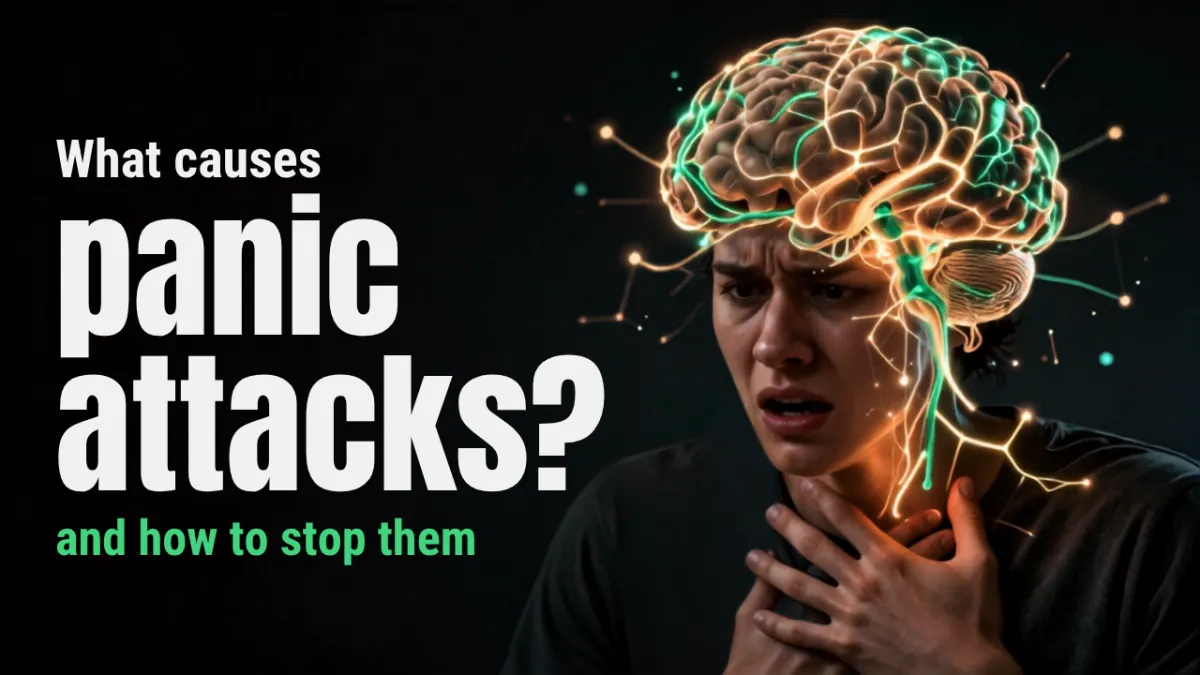
At the centre of every panic attack is a brain structure called the amygdala. The amygdala functions as the brain's alarm system, constantly scanning the environment for potential threats and triggering the body's fight-or-flight response when it perceives danger.
In a healthy, low-anxiety nervous system, the amygdala activates appropriately in response to genuine threats and then returns to baseline once the danger has passed. In a person with elevated anxiety, the amygdala becomes sensitised. Its alarm threshold lowers, and it begins firing in response to stimuli that pose no real danger at all, triggering a full fight-or-flight response with no genuine threat to respond to. That misfiring is a panic attack.
Research published in PMC (2024) on the brain mechanisms underlying panic attacks confirmed that the amygdala plays a central role, with panic disorder associated with altered functioning in the amygdala and related neural circuits, including the hypothalamic-pituitary-adrenal (HPA) axis that governs the body's stress response.
A systematic review published in Translational Psychiatry (Nature, 2024), analysing 33 peer-reviewed studies, identified patterns of altered neurotransmission in people with panic disorder, specifically lower receptor binding of GABA and serotonin in the amygdala. GABA is the brain's primary calming neurotransmitter. When GABA activity is reduced, the nervous system cannot regulate itself effectively, making panic attacks far more likely.
Panic Attacks Are a Signal, Not a Diagnosis
Here is one of the most important things to understand about panic attacks, and something that conventional treatment rarely emphasises clearly enough.
Panic attacks do not come out of nowhere. They are a symptom. They are the body's alarm system signalling that the underlying level of anxiety has risen to a point where the nervous system can no longer contain it.
Think of anxiety as pressure building in a system. As long as the pressure remains below a certain threshold, it manifests as general anxiety, worry, tension or unease. When the pressure exceeds that threshold, the system releases it through a panic attack. The panic attack itself is not the core problem. It is the signal that the core problem, elevated, unresolved anxiety, has reached breaking point.
This is why approaches that focus purely on managing panic attacks in the moment, breathing techniques, grounding exercises, medication, often provide only temporary relief. They reduce the pressure briefly but do not address the reason the pressure keeps building. The panic attacks continue because the underlying anxiety that generates them has not been resolved.
Resolving panic attacks permanently means resolving the anxiety that causes them. That requires a fundamentally different approach.
Why Managing Panic Attacks Is Not the Same as Resolving Them
Most conventional approaches to panic attacks are management strategies. They teach you how to cope with panic when it arrives. They do not teach the nervous system to stop generating it.
Breathing Techniques and Grounding Exercises
Breathing and grounding techniques are genuinely useful tools for getting through a panic attack in the moment. Controlled breathing reduces hyperventilation, which in turn reduces the physical intensity of the attack. But these techniques do nothing to lower the underlying anxiety level that caused the attack in the first place. The next trigger will produce the next panic attack, because nothing has changed at the root.
Medication
Anti-anxiety medications and antidepressants can reduce the frequency and intensity of panic attacks by altering neurotransmitter activity. For many people, particularly in severe cases, medication provides important short-term relief. But medication does not resolve the subconscious patterns driving anxiety. When medication is discontinued, panic attacks typically return, because the underlying cause is still there.
CBT for Panic Disorder
CBT is the most widely researched psychological treatment for panic disorder and does produce meaningful results for many people. A network meta-analysis published in PMC (2022), reviewing 74 randomised controlled trials with 6,699 participants, confirmed that face-to-face CBT is superior to treatment as usual for panic disorder. However, even face-to-face CBT typically requires months of weekly sessions, and a significant proportion of people with panic disorder do not achieve full remission.
CBT works primarily at the conscious level, helping clients reframe catastrophic thoughts about their physical sensations. It does not directly address the subconscious patterns, the neurochemical imbalances, or the physiological factors that keep the underlying anxiety elevated. For many people, it is a management tool rather than a resolution.
What Actually Resolves Panic Attacks: Treating the Anxiety That Causes Them
The most effective way to stop panic attacks permanently is to reduce the underlying anxiety level that generates them. When anxiety is resolved at its root, the nervous system calms, the amygdala's alarm threshold rises back to normal, and panic attacks stop occurring because the conditions that produced them no longer exist.
This is exactly what Newcastle Hypnotherapy's three-pillar approach achieves, typically within 4 to 6 weeks.
Learn more about anxiety and panic attack treatment at Newcastle Hypnotherapy
The Three-Pillar Approach to Stopping Panic Attacks
Pillar One: Clinical Hypnotherapy
Clinical Hypnotherapy is uniquely suited to resolving the anxiety that drives panic attacks because it works directly with the subconscious mind, the level at which anxiety patterns are stored and the amygdala's alarm threshold is set.
In a hypnotic therapeutic state, the conscious, analytical mind relaxes, allowing the therapist to work directly with the subconscious patterns that keep the nervous system in a state of high alert. By identifying and resolving the root causes of elevated anxiety, hypnotherapy does not just reduce the symptoms of panic. It removes the conditions that make panic attacks possible.
A study by Hammond (2010) using a randomised controlled trial with 45 patients with generalised anxiety disorder found that both hypnotherapy and CBT significantly reduced anxiety, but hypnotherapy showed more sustained long-term improvements than CBT. For panic disorder specifically, Bryant et al. (2005) found that hypnotherapy combined with exposure therapy produced significant reductions in panic attacks and overall anxiety in 30 patients.
The landmark Kirsch, Montgomery and Sapirstein meta-analysis, published in the Journal of Consulting and Clinical Psychology (1995), found that clients receiving hypnotherapy showed greater improvement than at least 70% of those receiving CBT alone, with some analyses putting that figure at up to 90%. For panic disorder, where the subconscious roots of anxiety are often deep and long-standing, that difference is highly significant.
A review published in Frontiers in Psychology (2024) confirmed that hypnotherapy has demonstrated efficacy across anxiety and mood disorders, with clinical trials reporting no serious adverse events, making it both effective and exceptionally safe.
Pillar Two: NLP (Neuro-Linguistic Programming)
NLP provides a powerful set of tools for dismantling the thought patterns and conditioned responses that sustain and amplify panic. Where hypnotherapy works at the subconscious level, NLP works at the intersection of conscious and subconscious processing, giving clients fast-acting techniques to interrupt anxiety spirals, change their relationship with physical sensations, and break the anticipatory anxiety cycle that so often develops after a first panic attack.
The anticipatory anxiety cycle is one of the most debilitating aspects of panic disorder. Once someone has experienced a panic attack in a particular situation, the fear of having another attack in that situation becomes its own source of elevated anxiety, which in turn makes another panic attack more likely. NLP techniques such as anchoring, reframing and pattern interruption can break this cycle rapidly, often producing noticeable change within a single session.
A systematic literature review published in World Scientific News (Nompo and Pragholapati, 2021), drawing on research from PubMed, ScienceDirect and ProQuest, concluded that NLP can reduce anxiety and promote lasting changes in behaviour patterns. A peer-reviewed study using the Liebowitz Social Anxiety Scale found statistically significant reductions in anxiety following NLP-based intervention.
Pillar Three: Nutritional Coaching
The role of nutrition in panic attacks is one of the most overlooked and yet most impactful factors in recovery. The neurochemical imbalances associated with panic disorder, particularly reduced GABA and serotonin activity in the amygdala, are directly influenced by what you eat.
Research published on PubMed by Norwitz and Naidoo (Oxford University and Harvard Medical School, 2021) established that nutritional interventions targeting the microbiome and systemic inflammation represent a high-yield approach to anxiety treatment. The gut produces approximately 95% of the body's serotonin. When gut health is compromised by poor diet, inflammation or microbiome imbalance, serotonin production is reduced, GABA activity is impaired, and the nervous system's capacity to regulate itself, including the amygdala's alarm threshold, deteriorates.
A 2024 review published in Frontiers in Nutrition (University of Surrey) found that pro-inflammatory diets high in sugar and processed foods can heighten anxiety and cause neurochemical changes, while antioxidant-rich diets measurably reduce anxiety. Addressing nutrition as part of a panic attack treatment programme provides the nervous system with what it needs to genuinely calm down, not just symptom by symptom, but at a physiological level.
Why People with Panic Disorder Choose Newcastle Hypnotherapy
Newcastle Hypnotherapy has worked with hundreds of clients dealing with panic attacks, including people who have been experiencing them for years and have tried multiple treatments without lasting relief. Here is what consistently distinguishes the outcomes.
100+ Five-Star Google Reviews
With over 95 verified five-star Google reviews, many specifically from clients who came to Newcastle Hypnotherapy after years of panic attacks, the clinic has one of the most compelling independent track records of any anxiety practice in the North East. Clients repeatedly describe not just a reduction in panic attacks but a fundamental change in how they feel day to day, as the underlying anxiety that was generating the attacks is resolved.
7 Consecutive Professional Awards
Seven consecutive years of independent professional recognition reflects a sustained, externally verified standard of clinical excellence that is exceptionally rare in the therapy world. For someone choosing where to seek help for panic disorder, that consistency matters.
10+ Years of Specialist Experience
Over a decade of dedicated specialist practice means the Newcastle Hypnotherapy team has worked with the full spectrum of panic disorder presentations, from first-episode panic attacks to long-standing, treatment-resistant panic disorder with agoraphobia. That depth of clinical experience shapes every session.
An Award-Winning Multi-Therapist Team
Newcastle Hypnotherapy is an award-winning team of specialist therapists, each highly qualified across Clinical Hypnotherapy, NLP, EFT, counselling and nutritional coaching. For clients with panic disorder, the breadth and depth of that combined expertise ensures the treatment approach can be adapted precisely to each individual's needs and history.
Rated #1 in Newcastle
Independently listed as the number one hypnotherapy clinic in Newcastle upon Tyne by ThreeBestRated.co.uk, assessed across a rigorous 50-point inspection covering history, reviews, standards, satisfaction, trust and pricing.
Results in 4 to 6 Weeks for Most Clients
For most clients dealing with panic attacks, meaningful and lasting resolution is achieved within 4 to 6 weeks. That includes many people who have been living with panic disorder for years. The difference is not that those clients were somehow easier cases. It is that the approach addresses the anxiety generating the panic attacks, rather than simply managing the attacks themselves.
You Do Not Have to Keep Bracing for the Next One
Living with panic attacks means living in a state of constant vigilance, always half-waiting for the next one, quietly adjusting your life to avoid the situations that might trigger it. That is not a life. And it is not something you have to accept.
Panic attacks are a signal. They are telling you that the anxiety underneath them has risen too high and needs to be resolved. When it is resolved, the signal stops. The panic attacks stop. And the life you had been quietly shrinking to accommodate them begins to open back up.
The first step is simply a conversation.
Book your free, no-obligation assessment call here
Or start straight away with the Free Anxiety Relief Pack, including a professional hypnosis audio, breathing guide and practical eBook, completely free with no strings attached.
Download your Free Anxiety Relief Pack here
To learn more about the anxiety and panic attack treatment programme:
Explore anxiety treatment at Newcastle Hypnotherapy
Newcastle Hypnotherapy is based at Dobson House, Regent Farm Road, Gosforth, Newcastle Upon Tyne, NE3 3PF. Online sessions available UK-wide.
References
PMC (2024). Brain mechanisms underlying panic attack and panic disorder. National Institutes of Health. https://pmc.ncbi.nlm.nih.gov/articles/PMC11178723/
Translational Psychiatry, Nature (2024). Neurochemical and genetic factors in panic disorder: a systematic review. https://www.nature.com/articles/s41398-024-02966-0
Frontiers in Psychiatry (2022). Neuroimmune mechanisms in fear and panic pathophysiology. DOI: 10.3389/fpsyt.2022.1015349
PMC (2022). CBT treatment delivery formats for panic disorder: systematic review and network meta-analysis of 74 RCTs, 6,699 participants. https://www.ncbi.nlm.nih.gov/pmc/articles/PMC9975966/
Kirsch, I., Montgomery, G., and Sapirstein, G. (1995). Hypnosis as an adjunct to cognitive-behavioral psychotherapy: a meta-analysis. Journal of Consulting and Clinical Psychology, 63(2), 214-220.
Hammond, D.C. (2010). Hypnosis in the treatment of anxiety and stress-related disorders. Expert Review of Neurotherapeutics, 10(2), 263-273.
Bryant, R.A., et al. (2005). Treating acute stress disorder: An evaluation of cognitive behavioral therapy and supportive counseling techniques. American Journal of Psychiatry.
Frontiers in Psychology (2024). The role of hypnosis in reducing anxiety. DOI: 10.3389/fpsyg.2024.1411835.
Nompo, R.S. and Pragholapati, A. (2021). Effect of Neuro-Linguistic Programming (NLP) on Anxiety: A Systematic Literature Review. World Scientific News.
Norwitz, N.G. and Naidoo, U. (2021). Nutrition as Metabolic Treatment for Anxiety. Frontiers in Psychiatry. DOI: 10.3389/fpsyt.2021.598119.
Basso, M., et al. (2024). Diet quality and anxiety: a critical overview with focus on the gut microbiome. Frontiers in Nutrition, 11. DOI: 10.3389/fnut.2024.1346483.
Your Next Anxiety Therapy Article:
Why You Must Interrupt Anxiety Early (Or It Becomes a Habit)