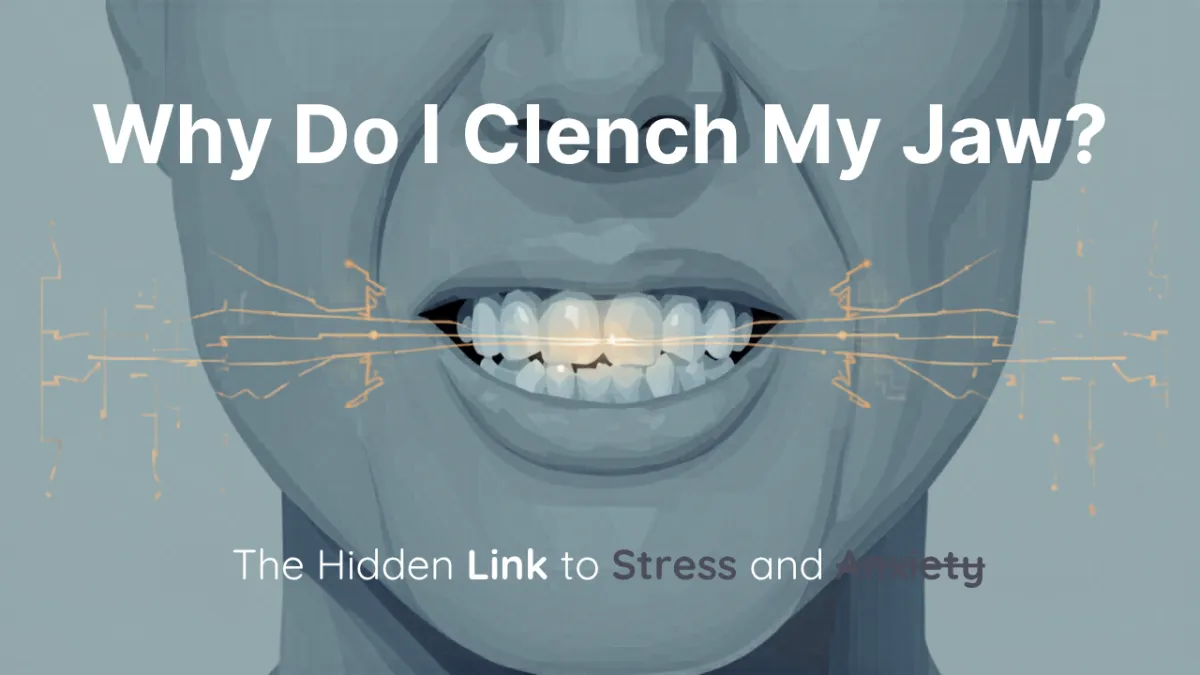
Why Do I Clench My Jaw? The Hidden Link To Stress and Anxiety
If you wake up with a sore face, a dull headache, or a clicking jaw, you are likely part of the growing number of professionals suffering from bruxism or TMJ issues. While dentists often suggest mouthguards to protect your teeth, a mouthguard is simply a shock absorber. It does not stop the clenching from happening.
To stop the pain, you have to understand why your brain is sending the "clench" signal in the first place.
Jaw clenching is just one symptom of anxiety issues. Professional anxiety help in Newcastle is just a call away.
The "Threat Response" in Your Mouth
Jaw clenching is one of the most primitive human stress responses. When your ancestors faced a physical threat, the body instinctively tightened the muscles of the jaw and neck to protect the airway and prepare for a fight.
In the modern world, your "threats" are deadlines, unread emails, and financial pressures. Your brain cannot distinguish between a predator and a high-stakes meeting, so it keeps the jaw in a state of permanent tension. This is known as a "Hyper-Vigilant" state.
The Subconscious Habit
Clenching often becomes an "unconscious loop." You don't realise you are doing it until the pain starts. This is because the habit is stored in the Basal Ganglia, the part of the brain responsible for automatic behaviours.
Traditional relaxation techniques often fail because they are conscious. You can tell yourself to "relax your jaw," but the moment you focus back on your work, the subconscious program takes over again.
Subconscious anxiety loops can quickly be resolved with professional anxiety treatment in Newcastle.
How to Break the Loop
To stop the clenching, we must address the "Neurological Software" and the "Biological Fuel" behind the tension.
1. NLP Pattern Interrupts
Using Neuro-Linguistic Programming (NLP), we identify the specific triggers that cause the tension to spike. We then "re-code" the response. Instead of the brain defaulting to "Stress = Clench," we train it to default to a "Micro-Release." This breaks the automatic habit at the source.
2. Clinical Hypnotherapy
Hypnosis is the fastest way to communicate with the Autonomic Nervous System. By entering a state of deep trance, we can reset the "baseline" tension of your facial muscles. This moves your body out of the "Fight or Flight" state and into the "Rest and Digest" state, allowing the muscles to soften naturally.
3. The Nutritional Connection
Many people are surprised to learn that jaw clenching is often exacerbated by Magnesium deficiency. Magnesium is the "Nature's Relaxant" for muscles. When you are stressed, your body burns through magnesium at an accelerated rate. Without enough of it, your muscles physically cannot switch off.
By combining Nutritional Therapy with neurological work, we address both the "Signal" (the brain) and the "Receiver" (the muscle).
Stop the Tension Before It Starts.
A mouth guard only protects your teeth; it doesn't solve the stress that causes the clench. If you are ready to switch off the "internal alarm" and wake up without pain, let’s talk.
Speak to a professional anxiety therapist today:
https://assessment.newcastle-hypnotherapy.com/
Useful Anxiety Treatment Articles By Newcastle Hypnotherapy:
How to Get Rid of Severe Anxiety: Why a Specialist Gets Results in Weeks, Not Months
Overcoming Anxiety, Panic Attacks & Trauma: Rob's Story
Brenda's Story: Anxiety Therapy Case Study