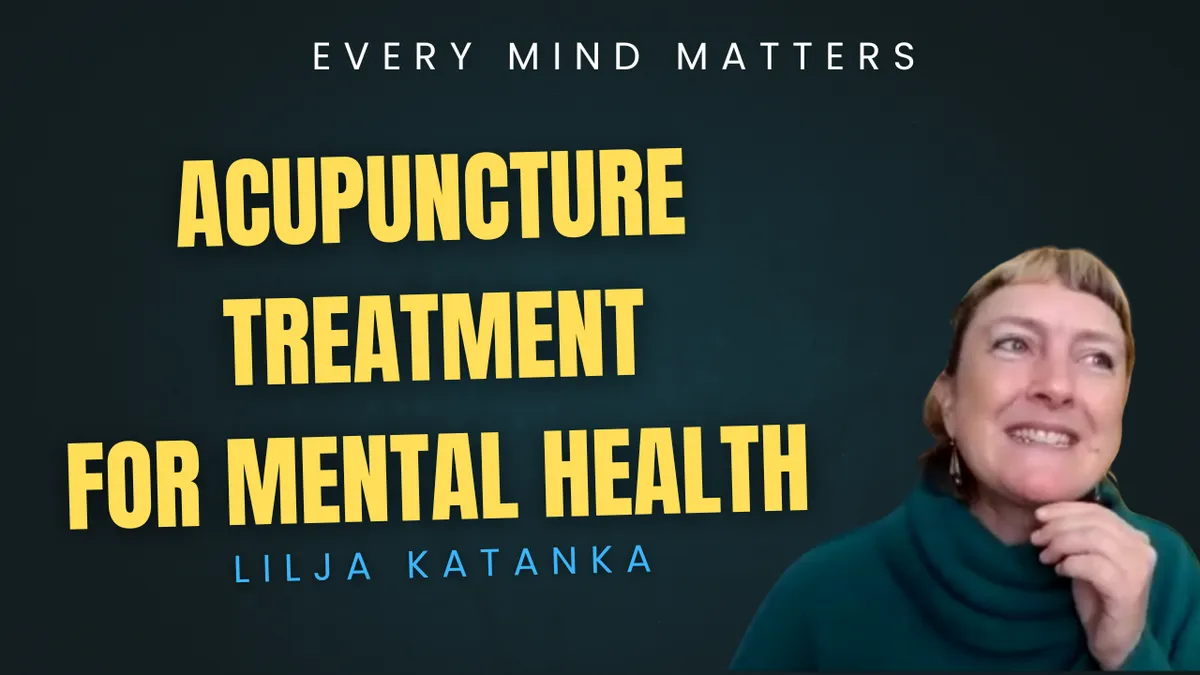
The Power of Acupuncture for Mental Health | Expert Insights with Lilja Katanka
Are you searching for a natural, holistic approach to manage anxiety, stress, or depression? In this insightful episode of "Every Mind Matters," host and anxiety therapist Mark sits down with acupuncture expert Lilja Katanka to explore the profound benefits of acupuncture for mental health.
Discover how this ancient Chinese medicine technique, which is over 5,000 years old, can help rebalance your nervous system, improve sleep, and provide relief from a wide range of mental health challenges, including anxiety, depression, trauma (PTSD/CPTSD), and hormonal and emotional issues like PMDD and perimenopause.
Lilja explains the interconnectedness of mind and body in Chinese medicine and how acupuncture offers a personalised treatment approach—a refreshing alternative to the one-size-fits-all solutions. Learn what to expect during a session, the potential side effects (which are mostly positive!), and how acupuncture can work as a standalone treatment or in conjunction with other therapies like hypnotherapy and counselling.
If you've ever been curious about acupuncture or are looking for a complementary therapy to support your mental well-being, this episode is a must-watch!
FREE GUIDE: How Acupuncture Supports Mental Health Download your complimentary copy to learn more about holistic wellness. https://www.lifeisforlivingwell.co.uk/acupunctureformentalwellness
About Lilja Katanka: Lilja is an acupuncturist who trained to degree level almost 20 years ago and has practised ever since. Her style is neoclassical acupuncture, often using very few needles, alongside dietary advice from a Chinese medicine perspective. You can find her at Life Is For Living Well.
Key takeaways from the episode
Acupuncture uses very fine needles at carefully chosen points, and Lilja sometimes treats with just one needle.
Two people with “anxiety” can need quite different treatment. She looks at each person’s symptoms, triggers, sleep and digestion rather than giving everyone the same approach.
Lilja works with anxiety, insomnia, depression, trauma, hormonal mood issues such as PMDD and perimenopause, and the overwhelm that can come with neurodivergence.
Acupuncture can sit alongside talking therapy and hypnotherapy. It can help people get to the point of starting therapy, or work on a physical level when they’ve already analysed everything they can.
A first session includes a full consultation, then the needles stay in for around 10 to 15 minutes. Many people feel relaxed and sleep well that night, and some feel tired for a day.
Acupuncture isn’t regulated in the UK, so she advises checking your practitioner is trained to degree level, for example through the British Acupuncture Council or the Association of Acupuncture Clinicians.
To look after her own mental health, Lilja sea swims two or three times a week, walks, grows her own veg and herbs, and keeps up friendships.
Related reading
Lilja talks about rebalancing the nervous system. Read What Is Nervous System Regulation, and Why Does It Matter for Anxiety?.
If anxiety is affecting you, find out how we help at Anxiety Treatment in Newcastle.
Video Transcript
So, hello and welcome to another episode of Every Mind Matters. My name is Mark and today we're talking about the benefits of acupuncture for mental health. And today I'm here with the lovely Lilja. Hope I'm saying that right. Who's going to share her expertise. Thank you so much for joining us. Well, thank you for having me. You're welcome. You're welcome. Okay. So, it was interesting when we first connected that I'd not thought about acupuncture for mental health. And then somebody reminded me that quite often hypnotherapists use tapping, EFT tapping.
And I'm told that acupuncture points. Is that right? Yeah. To be honest, I don't use tapping so much and I don't know too much about it. But yeah, I understand it's certain points like kidney 27 I think is one of them on the collarbone and different areas that can help sort of reset the nervous system and meridian system. So yeah, a lot of these therapies are connected as we'll probably see. But yeah, because Chinese medicine is very old. It's like up to 5,000 years old actually. So I a lot of holistic therapies of course just have different ways of describing the paths of energy through the body but ultimately you know we're all bodies and humans so different ways of describing the same thing can be useful.
Yeah. Okay. So let's start. What exactly is acupuncture for people who don't know? Well it is it sort of most simple form. Use of very fine needles to stimulate different acupuncture points around the body. Those points are chosen very carefully for the individual and they're on meridians are associated with different organ systems or meridian systems that have kind of different correspondences in Chinese medicine. So with potentially one needle or several needles, we're trying to help the body restore balance in those organ systems or elements.
So yeah, that's a very kind of basic summary, I guess. Good. Okay. And from a mental health perspective, how can acupuncture help there? Well, with Chinese medicine and again with the other holistic therapies, everything is connected. You know, the mind is not separated from the body. So we're always looking at things from that kind of interconnected perspective. You know on a more modern sense or western sense we can be helping rebalance the nervous system support vagal tone heart rate variability circulation of fluids and blood and everything but we're looking at it from a different perspective and very much individualised as well.
So, for example, you know, we might have five people with anxiety that have been diagnosed with or self diagnosed, but we kind of maybe want to look into the specific symptoms for that individual or what can trigger their anxiety, whether it's more of a physical reaction or a mental reaction if it affects their sleep or digestion or all of those aspects kind of give us clues as to which system is out of balance and therefore how we can support that individual to get back into balance and therefore support their mental health as well as ideally all their other symptoms at the same time.
Good. I like what you said there because a common thing we get is people approach us and say I've got anxiety. How much is it to sort it out and we have to do an assessment because it can be very different from person to person. Absolutely. Yeah. Exactly. So some people they get like massive panic attacks or palpitations. For some people it's kind of more a sense of general angst or hypervigilance. For some people as I say it's kind of thoughts going round and round and around they can't stop or catastrophising. And yeah, as I say, all of those are kind of clues as to how we can best support them to rebalance that rather than just taking the pill that will hopefully blunt things.
We want to really kind of try and get to the bottom of things so that the system can be supported. Yeah. I like that because there are so many This is what the doctors seem to do is they just give one pill that helps everybody. Yeah. And actually when we work with those clients, we find it doesn't seem to help anybody or not very many and that individual sort of response side effects that we want to avoid you know and each of those medications can have various obvious side effects but also can affect your gut gut microbiome, your nutrient assimilation.
So you know we can support that as well rather than depleting it. So and as we know more and more you know how much the gut microbiome affects your mental health. So again modern research is coming back to the interconnectedness in a way. But yeah so if we can help them without any of these side effects and almost the opposite the side effects are usually beneficial then let's do it. Yeah. So you mentioned Chinese medicine. H is that very big on acupuncture or has it got a lot of other parts to it as well? So Chinese medicine is where acupuncture originated.
Chinese medicine also includes Chinese medicine herbs. It includes cupping, it includes gua sha, it includes some other modalities, tui na, qigong certain types of breath work. So as I say that's where it originated. I basically just do the acupuncture side of things with some dietary therapy that is from a Chinese medicine perspective. As say I focus on acupuncture. I don't do the herbs. It's a whole another amazing specialism. But there's also a lot of acupuncture that has kind of been evolved since then. So there's different styles of acupuncture.
There's the more classical traditional Chinese medicine style. There's lots of Japanese styles of acupuncture, Korean styles. And I mainly now work with style called neoclassical acupuncture, which is kind of going back to the classics, but interpreting them in a different way. And this is where we're using minimal needles, as I say, sometimes just one needle. And getting instant feedback from the body to ensure that we've chosen the right point and that the body is responding as we would So it's very exciting. Good. So what sort of mental health issues can acupuncture help with?
What can't it help with? So I work with people I say from a whole spectrum. So a lot of people with anxiety, insomnia, I guess they're the kind of more common ones. Which as you know as you say is like a whole spectrum of things anyway but of depression of course trauma, C-PTSD some people come with more hormonal emotional issues like PMDD or premenstrual issues or perimenopause menopause. So kind of the whole spectrum really. Some people you know with neurodivergence issues that obviously are not illnesses but we can help support the anxiety or overwhelm that comes alongside those.
So yeah the whole gamut I suppose you're covering the whole range. That's yeah basically impressive. Yeah, because there are there's an awful lot of mental health issues that one of the things we've seen now is the NHS don't seem to be able to help people as much as people are trying within that sort of organization and we're seeing a lot of people with depression and severe anxiety or PTSD that really aren't getting the help and it's good that there's more alternatives out there. Are there any that seem to work better or less for certain mental health issues?
It's hard to know. Some things I suppose you get it takes a bit longer to see a response and if people are on medication already sometimes the response is a little bit slower or you know we can help them if they're interested in reducing the medications obviously with alongside their doctors and everything but sometimes we get a really rapid response but also I feel like it works really well alongside talking therapy sometimes or sometimes it's the help they need to be able to do talking therapies. So sometimes people aren't able to kind of vocalise what's wrong and we can kind of get them to a level where they can get to that next stage of getting therapy or hypnotherapy or something or the other way around.
Sometimes people have had all the therapy they can analyze and they can analyze and they know logically all of these things but maybe we need to work a bit more somatically or on a different layer as to letting that kind of actually process and become part of their being. I suppose that understanding that it is actually okay or it is in the past or it's doesn't need to be part of their identity anymore. Ah I like that. Something we talk about a lot is the identity because a lot of people we find have they always say this I've been anxious for so long I've always done this and we have to try and change that story that identity because if people get stuck in that it's a lot of hard work.
Yeah. And I think, as I say, that's where I think it can work really well alongside hypnotherapy to kind of bring that together, that kind of subconscious retraining and the neurological retraining, but also embodying that potentially. And it's totally understandable when people have had things for a long time. Same with chronic pain and stuff. It's like you've almost just got so used to that being part of you, it's very hard to imagine how your life could be in a different way. So that is an interesting aspect. And I think it's also really interesting.
Sometimes I've helped people when they've been to a retreat or use particular medicines and again it just hasn't quite integrated completely. So the active country because they can really kind of help reconnect that sort of realization with the embodiment of it is yeah is very fun sort of beautiful part of the job when people kind of just almost take that breath in and yeah kind of have that connection. Brilliant. So tell us about your story. How did you get into this? Well I was always one of those children that asks too many questions. So I think just western medicine never really answered all my questions properly.
I felt like I used to have a lot of eczema for example and you know they would give me the steroid cream and it would stop the itching but of course if I stopped using the cream it would come back and I was like this obviously isn't getting to the bottom of things. And I like getting to the bottom of things. So I wanted to look at things a bit differently. So I was always interested in reading stuff about complementary therapies. Got to do all these things when I was quite young. And then I did work experience with an acupuncturist when I was 14.
Yeah. And then a couple years later he treated me when I had some quite serious glandular fever. And so I experienced firsthand that kind of instant relief and had some ongoing treatment to sort of deal with the chronic the sort of post-viral issues that I was experiencing. So then I had a lot of like ginger and herbs and all that. And then yeah, so over the years I have always kind of veered more towards I guess more holistic therapies. And then was working in sustainable development charities for a while after my first degree. But again almost felt like we weren't really getting to the crux of things.
So realised I'm better working one-to-one with people really. And hopefully by helping people feel their best self, they can also have a wider impact on the world and their community. So yeah, kind of it all came back to acupuncture in the end. Good. I like that you're working with people and you help them to get a benefit and then there's a benefit out to the people around them in the world. And I do like that sort of attitude in therapist. I think it's so important to recognise, isn't it? You know, even as a small thing, you know, you smile at someone in the street, you help their day.
Like we can have such an impact when we're feeling in the right place for it. And when we're in pain and we're suffering and we're anxious, we can't make the best decisions for ourselves or for other people around us. And we can't necessarily be our best selves. So, you know, another reason it's, you know, it's not selfish to look after yourself. It's really important for everyone. And we can just all kind of spread that love. Yeah. It's all sort of so interconnected on so many levels. It's absolutely. Yeah. Good. So, for somebody who's never tried acupuncture, what does it feel like?
What what is a session like? So so say in the type of acupuncture I do, we'll, you know, we'll have a little chat. We'll do a thorough consultation, medical history, all of that stuff. We'll get you comfortable on the table. I will be feeling your pulses. I'll feel different areas on your tummy, your arms, legs and kind of almost checking in with the body as to where the obstacles might be. And then we will choose, as I say, what potentially just one point or several points. And then we'll just keep checking back in with any of those tender areas to check that they have released.
And if you have any pain at time, then we'll check that if that's released or if that's at least improved significantly. And then we'll just let you relax and let the needles do their thing for sort of 10 15 minutes or so. People zone out, people fall asleep, people feel heavy or light or generally chill out. And then we see how they're getting on. Good. And what sort of results can people realistically expect from acupuncture? Again, it does vary of course depending what they're coming for and their general constitution and how long they've been struggling with that particular issue.
The immediate response is almost always just feeling very relaxed. Floating off into the day. Usually have a really good sleep that night. People are often just like that's the best sleep I've had for years. And then as I say, very variable. Like if it's a pain or an injury, they'll often find very quick relief, but it might only end last a few days after the first session, and we might need a few sessions to kind of really shift that. If it's more of a cyclical hormonal thing, then of course we need to work with people a little bit longer to be able to even check in, you know, with how it's going with the cycles.
But generally hopefully they just notice that nervous system being a bit clearer and lighter and as I say being able to kind of make better decisions, feel a bit less overwhelmed, less anxious and things kind of gradually just come easier. Good. And would you class this as a standalone treatment or is it more of a used as a complementary sort of thought process? It can be either. It can work very well alongside other treatments or other modalities, but it certainly can be a standalone treatment as well. I mean, I usually give some kind of lifestyle or dietary advice.
I'm not a nutritionist or anything, but from the Chinese medicine perspective of what things might support the imbalance that I have potentially diagnosed. But lifestyle is always an issue. You know, if people are have a treatment and then they run off and do something that's very bad for them, like it's probably going to mess up the treatment a bit. But again, hopefully we're helping them so that they just naturally also feel like they make better decisions for their own health. So, yeah. So, say it can be either. Of course, if people are already taking medications or herbs, then we work alongside those and try and support that balance or support any side effects, help ameliorate any side effects.
So yeah, maybe either either. Good. And are there any side effects? I know with a lot of medication, we can see an awful lot of problems. Where does acupuncture stand when it comes to side effects or things we should be aware of? Generally people as I say generally feel quite relaxed have good sleep. Temporarily people can feel exhausted. So maybe for the first day or so and I find that especially when people have been kind of running on empty for a while and their adrenals are a bit like this. Then sometimes it's kind of that reset to just almost force them to rest for a little bit.
Sometimes people yeah do feel a little bit unwell afterwards. It's very rare. I try not to create that kind of, you know, detox reaction too much. But sometimes, as I say, people just feel a bit tired or sometimes a little bit achy. Some of the points can feel a bit achy. But generally the side effects are positive. Good. And is there any scientific evidence, any research to show how effective this can be? Yeah, there is actually tons of research out there. I don't know if I've got much linked on my page, but there are lots of organisations doing the research.
Lots of research from China and Japan. But one of the issues of course with researching holistic therapies or getting the research published is that you know randomized control trials are the gold standard for research supposedly but they are designed for pharmaceuticals. So, if you're not doing like a one-size-fits-all treatment, it's very difficult to do that kind of double-blinded control trial because you can't just have like 100 migraine patients and give them the same treatment and expect the best results because you need that you know patient practitioner individualised relationship.
But despite that, there are lots of really positive studies about acupuncture. And there's also one I've got a laser that I can use instead of a needle. If people really hate needles, but obviously can't have them for some reason. But the interesting thing with the laser is that you can more easily do the double blinded control trial because technically I wouldn't know if the laser was on or active. So that's another interesting aspect of acupuncture research that's potentially coming to the forefront. But yeah, there is lots of research. It's been going on a very long time.
It's super safe in the right hands. But yeah, there are risks. You need training in the sense that I do worry now that there's a lot of horses. It's not regulated acupuncture. So they haven't posted something today. I'm getting advertised courses that are like three-day online courses to do acupuncture and dry needling and you're like it's a bit it's a bit scary. Because yeah it's not something you want to go to an untrained practitioner I would say. You know it's not massively risky. The needles are tiny and all of these things, but at the same time, you know, I don't think you can get enough training or experience in three days or no, whatever to be able to give a really good treatment.
So yeah. Yeah. We saw a similar thing over lockdown. There was a lot of people sitting there with nothing to do and they started to go and enroll on courses, especially in hypnotherapy and NLP and yeah, same sort of thing. Learn this in a day or three days or a week. And they then go out and start working with clients and then we're getting phone calls of other hypnotherapists saying, "I've got this client. I've got this problem. I don't know how to sort it." And it's very, very basic stuff that should have been covered in decent training. And they're asking you for your advice.
And they're asking me for advice, expecting it for free, which was really interesting. But we started to see complaints of lots of different industries of the same thing. And like you, hypnotherapy really isn't regulated in the UK. And anybody can sort of go and doing it. And it's hard to find which practitioners and therapists are really well-qualified and got the experience. And that's something I think everybody needs to do a bit of research on. Yeah. Because there are there's some people out there with no with no practice time which is really really scary.
It is troubling. Yeah. So yeah I did a degree course in a culture well yeah almost 20 years ago. And I've been practicing ever since. So I'm quite experienced and there's so if you go to the association of acupuncture clinicians everybody on there is degree level trained so that's kind of a register of people and also the British acupuncture council everybody is degree level trained but yeah there's other registers for dry needling or medical acupuncture which is a bit of a different different category but Yeah, those are the ones I'd recommend for people who want to find a qualified person.
That's good. That's good. And and where do you see acupuncture going at the moment? Do you find that sort of complementary therapies are picking up speed and a lot more people are looking at them? Well, it's an interesting question because of the lack of regulation. So, you know, some doctors, nurses and stuff are providing it having done a couple of weeks course. So in a way that's helping gain acceptance and trust of acupuncture. I feel like it's getting more accepted. Yes. And one of the interesting things that I think is a lot of the private health insurers also cover function now.
And what I think is interesting about this is that you know they're not doing it for their own benefit are they? They know that it helps people feel better and be less ill. So they're only interested in their bottom line really, aren't they? So they're only going to pay for things that are long-term going to help them financially. So I think that's maybe a bit of a sign of the way things are going. Not that I want everyone to have to have private medical insurance, which is another worry about the whole system at the moment. But as I say, maybe it's a bit of an indicator that it's becoming more accepted and trusted and valued.
That is a worry. It's a shame because on on my family side, my dad used to be a director of a psychiatric hospital and he worked really hard to get standards up and we've seen sort of the funding be cut year after year. And now we're seeing so many people saying they feel rather let down by the NHS if it's not physical stuff, anything mental health. Are you finding that sort of experience at the minute? Yeah, I mean, as you said, people can get referred to CBT, but the waiting lists are so long. And really the doctors are so limited. Yeah, they only really have medication to offer.
But yeah, I mean I see people who are usually at the end of their death for physical things or mental things. They're kind of physical things. They're like, "Look, I'm got an 18-month waiting list until I'm going to see a get a scan or see a msk specialist." So maybe you can help me in the meanwhile and hopefully I do help them and maybe they can avoid surgery. But the same with all of it really. Yeah. They've kind of tried this, they've been to the doctor, they've been sort of ignored or sent away or don't really want to be on medications. So they come to me as a last come earlier, but I'm glad I can help them eventually.
Yeah, it's a shame that we're kind of end of the line for an awful lot of people, but then things but and I wish I could offer it free on the NHS, but I know it'd be lovely if we could do that, but it's there's just no funding out there for our sort of work, is there? No, unfortunately. No. So, what is it that you do to look after your own mental health? I do as much as I can. I get out in the sea two or three times a week. I feel like that's been so good for me. Partly because of the community of it, but partly just being out in nature, getting out in the morning.
Walking. I do quite a lot of walking out and about garden stuff, which I'm very behind on, but I try and grow my veg and herbs and things like that. And yeah, just seeing people. For me, friends and family are so important to my mental health. And I think having a sense of community is so important and I feel like that's one of the reasons I'm so happy to live up here as well. It's such a good friendly community. And even building relationships with other practitioners is so great to be able and have another layer of community and that we can sort of look after each other.
So those are main things. I take all my supplements. I try and eat well. I do the thing. Try and rest sometime. Get some good sleep. Good. Yeah. Brilliant. Thank you so much for that. If people wanted to get in touch with you, how could they find you? Yeah. I've got my website. Hopefully you can add links to these things. It's lifeisforlivingwell.co.uk. My Instagram is my full name, Lilja Katanka. And I've got a Facebook as well. Life is living well I think. And just email or drop me a text or a WhatsApp and I be happy to answer any questions. I'm also going to add a free download to the website which again I'll send you the link for with a little summary about acupuncture for mental health.
So if you want to download that then click on the link and get in touch and I would love to hear from people. Lilja, thank you so much for that. That's been so interesting. I'm sure a lot of people are going to enjoy this and hopefully we can push a few more people your way to get the help that they need. Thank you and lovely to meet you and yeah, hopefully it sends some people to you too and thanks for having me. You're more than welcome. Thank you all so much for watching. We'll see you in the next video.
Explore & Connect: 🌐 Website: lifeisforlivingwell.co.uk 👍 Facebook: facebook.com/Lifeisforlivingwell
Your Journey to Calm Starts Here.
The team at Newcastle Hypnotherapy has created these resources with you in mind.
For Immediate Support: 🌿 The Free Anxiety Relief Pack A gentle collection of tools designed to bring you peace in moments of overwhelm.
https://www.newcastle-hypnotherapy.com/free-anxiety-relief-pack-newcastle-hypnotherapy
For Personalised Guidance: 💬 Book a Free Anxiety Assessment Call Let's talk. If you're considering 1-on-1 or group coaching, this call is the perfect first step to see how we can help. Find a Time That Suits You Learn More Here.
For Deeper Insight: 🔬 Discover The Optimum Health Test Explore the connection between your physical health and mental well-being to address the root causes of anxiety. Learn More Here
Find more Every Mind Matters Podcasts here
https://www.newcastle-hypnotherapy.com/every-mind-matters-podcast