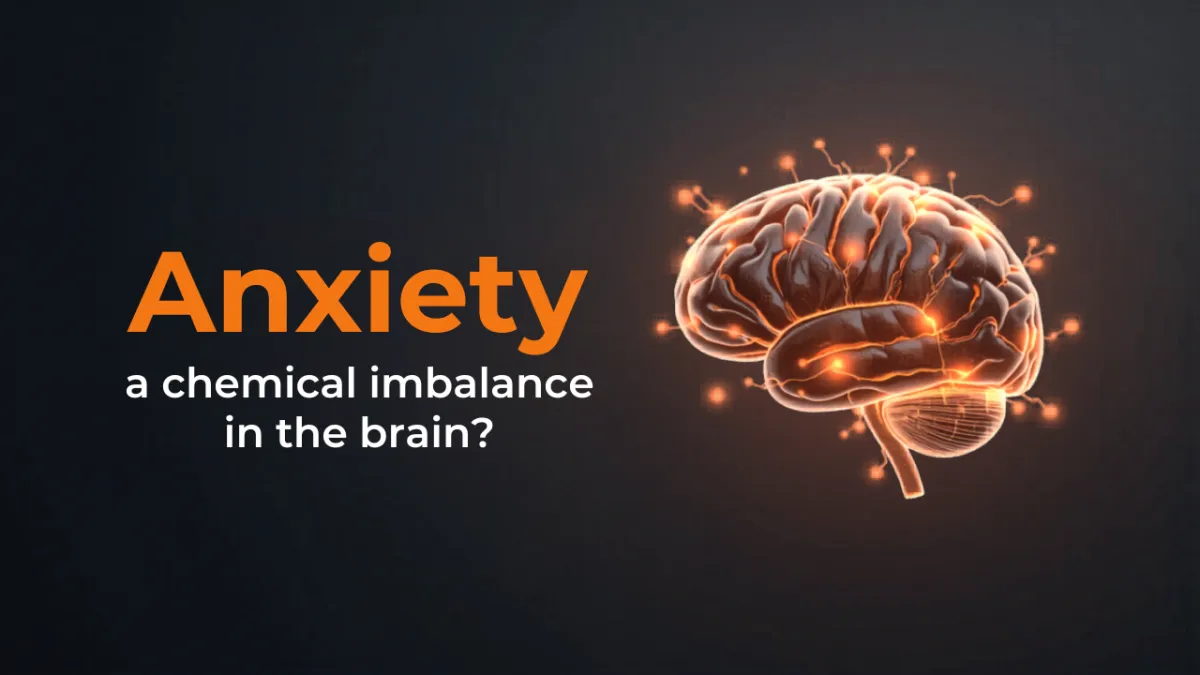
Is Anxiety a Chemical Imbalance in the Brain? The Truth.
If you have ever visited your GP about anxiety, there is a reasonable chance you were told, directly or indirectly, that your brain chemistry is off. That something is missing. That your serotonin is low, and that is why you feel the way you do.
It is a tidy explanation. It implies a simple solution. And for decades, it was the dominant theory behind how anxiety and depression were understood and treated.
There is just one problem with it. It is not quite right.
Modern neuroscience has moved well beyond the chemical imbalance model. Researchers now understand anxiety as something far more complex, far more treatable, and in many ways, far more hopeful. Because if anxiety is not simply a deficiency in your brain chemistry, it is not something you are stuck with for life. It is something that can genuinely change.
In this article, we want to explain what we now know about what actually causes anxiety, why so many people develop it, and crucially, what can be done about it.
Looking for anxiety therapy in Newcastle upon Tyne or online?
The chemical imbalance theory: where it came from and why it has been overtaken
The idea that depression and anxiety are caused by low serotonin became popular in the 1990s, largely driven by the success of SSRI medications, which work by keeping serotonin available in the brain for longer. Because SSRIs helped some people feel better, it was assumed that low serotonin must be the underlying problem.
But that logic has a flaw. Taking paracetamol relieves a headache, but that does not mean headaches are caused by a paracetamol deficiency.
Modern research has confirmed that anxiety is not the result of a single neurotransmitter being too low. As one comprehensive review puts it, anxiety disorders are now understood as intricate disruptions in neural circuits involving the amygdala, prefrontal cortex, and multiple neurotransmitter systems, not a simple chemical shortage.
This matters enormously, because it means that telling someone their anxiety is a chemical imbalance, and prescribing them medication to correct it, addresses a symptom at best. It does not touch the underlying cause.
Anxiety is not due to a lack of medication. Anxiety is the result of something the brain has learned, experienced, or been subjected to over time. And what the brain has learned, it can unlearn.
At Newcastle Hypnotherapy, we use a three-pillar approach to anxiety that addresses its real roots: Clinical Hypnotherapy, NLP, and Nutritional Coaching. If you would like to understand more about how this works, visit our anxiety treatment page or download our free anxiety relief pack.
Cause 1: Trauma and the anxiety habit
In our practice, roughly half of the clients who come to us for help with anxiety have experienced a significant traumatic event at some point in their lives. This is not a coincidence.
Trauma is one of the most powerful triggers for anxiety because of what it does to the brain, specifically to a small almond-shaped structure called the amygdala.
The amygdala is your brain's threat-detection centre. Its job is to identify danger and trigger the fight-or-flight response fast, before your conscious mind has had time to think. In normal circumstances, this system is incredibly useful. In people who have experienced trauma, it can become overactivated in a way that generates anxiety long after the original threat has passed.
Here is what happens at a neurological level. A traumatic event creates a powerful memory trace. The amygdala essentially burns the emotional signature of that event into the brain, encoding not just the event itself but all the sensory details surrounding it. The smell in the air, the time of day, the tone of voice, the physical sensation.
After the event, the amygdala remains on high alert. Its sensitivity is heightened. It begins to scan for threats constantly, and it starts to associate ordinary, harmless situations with the original danger. Someone who was in a car accident may feel a surge of panic at the sound of screeching brakes. Someone who experienced a difficult workplace may feel their body flood with dread every time they receive an email from a senior colleague, even in a completely different job.
Research has confirmed that trauma leads to heightened, persistent activity in the amygdala, keeping the nervous system in a state of readiness that becomes indistinguishable from chronic anxiety. The prefrontal cortex, which is responsible for rational thought and calming the amygdala down, becomes less able to regulate this response.
The result is what we describe as an anxiety pattern. The brain has run this circuit so many times, responding to threat with fear, that it becomes deeply habitual. The anxiety fires automatically, often without any apparent trigger, because the neural pathway has been reinforced so many times it has become the brain's default response.
This is not weakness. It is not a character flaw. It is neuroplasticity, the brain's ability to adapt and learn, working exactly as it is designed to. The extraordinary thing is that neuroplasticity works in both directions. A pattern the brain has learned, it can also unlearn. New neural pathways can be established. The amygdala can be recalibrated. The anxiety habit can be broken.
Cause 2: Long-term stress as an anxiety trigger
Not every anxiety story involves a single dramatic event. For many people, anxiety develops gradually, as the cumulative result of being in a prolonged state of stress.
When we experience stress, our body releases cortisol and adrenaline, hormones designed to help us respond to a challenge. In short bursts, this is healthy and normal. But when stress becomes chronic, when someone is dealing with financial pressure, relationship difficulties, a demanding job, or ongoing uncertainty over months or years, the stress response never fully switches off.
Over time, the nervous system adapts to this chronic activation. It essentially recalibrates to a higher baseline level of threat readiness. The brain, experiencing stress as its normal state, starts to generate anxiety as a background condition. Worry becomes habitual. Sleep is disrupted, which further elevates cortisol levels and makes everything feel worse. The body stays tense. The mind races.
This is the anxiety habit being formed through a different route. There is no single traumatic event, but the end result is similar: a nervous system that has been conditioned to respond to life with fear, and a brain that has practised anxiety so often it has become automatic.
This is also why so many people find that anxiety does not resolve simply by removing the stressor. The job changes, the relationship improves, the circumstances get better, but the anxiety remains. Because by that point, the pattern is in the nervous system. The external situation was the cause, but the anxiety has taken on a life of its own.
Cause 3: Your gut health and serotonin production
This is the cause of anxiety that surprises people most, and it is one that the medical profession is only beginning to take seriously.
Most people assume that serotonin, often called the feel-good neurotransmitter, is made in the brain. The reality is that up to 95% of the body's serotonin is produced in the gut, by specialised cells in the gastrointestinal tract that are directly influenced by the health of your digestive system and the composition of your gut microbiome.
When the gut is functioning well, serotonin production is supported and the gut-brain axis, the network of hormonal and neural signals that connects your digestive system to your brain, operates in a way that supports balanced mood and reduced anxiety. When the gut is compromised, serotonin production can fall, and anxiety levels rise.
A number of common digestive issues can impair serotonin production and contribute to anxiety:
Food intolerances: Undiagnosed intolerances, particularly to gluten or dairy, create ongoing inflammation in the gut lining that disrupts serotonin-producing cells and their signalling pathways.
Low fibre intake: Beneficial gut bacteria, which play a key role in regulating serotonin production, rely on dietary fibre as their primary food source. A low-fibre diet depletes these bacteria and reduces serotonin-supporting signals to the gut lining.
Candida overgrowth: An overgrowth of Candida in the gut disrupts the microbiome, interferes with nutrient absorption, and has been linked in research to impaired zinc and vitamin B6 levels, both of which are essential for the production of serotonin and other mood-regulating neurotransmitters.
Gut microbiome imbalance (dysbiosis): Research published in peer-reviewed journals has confirmed that an imbalanced gut microbiome disrupts serotonin signalling, with studies showing that mice raised without any gut bacteria produced around 60% less intestinal serotonin than those with a healthy microbiome.
Vitamin and mineral deficiencies: Low levels of magnesium, zinc, vitamin B6, vitamin D, and omega-3 fatty acids, all of which are commonly depleted in people with poor gut health, are closely associated with elevated anxiety levels. These nutrients are cofactors in the biochemical processes that produce serotonin and regulate the nervous system.
What this means in practice is that two people can present with identical anxiety symptoms for very different underlying reasons. One person's anxiety may be primarily trauma-driven. Another's may be rooted in years of gut dysfunction quietly undermining their neurochemistry. Treating both with the same approach will not produce the same results.
This is why we incorporate Nutritional Coaching as one of the three pillars of our approach at Newcastle Hypnotherapy, and why we use the Optimum Health Test as a starting point for clients where digestive or nutritional factors may be contributing to their anxiety. This comprehensive test examines gut health markers, microbiome composition, vitamin and mineral levels, and food intolerances, giving us a precise picture of what is happening biochemically rather than making educated guesses. It significantly speeds up progress because we can address the root cause rather than working around it.
If you suspect your gut health may be contributing to your anxiety, the Optimum Health Test is a powerful first step. Speak to us about this as part of your free anxiety assessment.
Cause 4: Learned anxiety from the people around us
Anxiety often runs in families. Parents see it in their children and assume it must be genetic, passed down through DNA. And while there is a modest genetic component to anxiety vulnerability, the far more significant mechanism is something else entirely: learned behaviour.
Children are extraordinary observers. From their earliest years, they are watching the people around them for information about how to interpret the world. Is the world safe? Is uncertainty something to be curious about or afraid of? Is this situation dangerous or manageable?
A child who grows up watching a parent respond to everyday challenges with anxiety, who witnesses chronic worry being modelled as the appropriate response to uncertainty, will often internalise that pattern. Not because they inherit anxious genes, but because their brain literally learns anxiety as the normal way to respond to life. The neural pathways associated with anxious thinking are built and reinforced during childhood because that is what they have observed and mirrored.
This is sometimes called intergenerational anxiety, and it is extremely common. It is also, importantly, not the child's fault, and not the parent's fault. It is simply how human brains are designed to learn, through observation, repetition, and modelling.
The hopeful implication is clear. If anxious responses are learned, they can be replaced with new, calmer patterns. The brain that learned to be anxious can learn to be at ease.
Other contributing causes of anxiety
Beyond the major causes above, there are several other factors that can contribute to anxiety developing or persisting:
Sleep deprivation: Even modest sleep disruption elevates cortisol, heightens amygdala reactivity, and weakens the prefrontal cortex's ability to regulate emotional responses. Poor sleep and anxiety reinforce each other in a cycle that can be difficult to break without addressing both.
Hormonal changes: Fluctuations in oestrogen and progesterone, whether due to the menstrual cycle, perimenopause, postpartum changes, or thyroid dysfunction, can significantly amplify anxiety. Many women experience their worst anxiety at specific hormonal phases without ever connecting the two.
Stimulant overconsumption: High caffeine intake, particularly in people who are already predisposed to anxiety, directly activates the body's stress response and can sustain a low level of physiological anxiety throughout the day without the person identifying the cause.
Social isolation and disconnection: Humans are neurologically wired for connection. Prolonged isolation, or the experience of feeling misunderstood or unseen, activates the same brain regions involved in physical threat, and can both trigger and maintain anxiety.
Unresolved grief or loss: Significant loss that has not been fully processed often manifests as ongoing anxiety. The nervous system remains in a state of incompletion, searching for resolution that hasn't arrived.
So how do we actually resolve anxiety?
Understanding the real causes of anxiety points us directly toward what effective treatment looks like. It is not about suppressing symptoms. It is about addressing what actually created the anxiety in the first place.
At Newcastle Hypnotherapy, our approach works across three pillars:
Clinical Hypnotherapy
Hypnotherapy works directly with the subconscious mind, where anxiety patterns are stored and reinforced. Using the latest neuroscience-based techniques, we are able to access the neural pathways that underpin the anxiety response and replace them with new, calmer patterns. This is not stage hypnosis. It is a focused, evidence-supported process that works with the brain's natural neuroplasticity to create lasting change at the root level rather than the surface.
Most of our clients begin to notice significant shifts within the first two to three sessions. The majority complete their work within four to six sessions.
NLP (Neuro-Linguistic Programming)
NLP techniques help to identify and change the specific thought patterns, internal language, and mental representations that keep anxiety active. Many anxious people have highly consistent but unconscious mental habits, ways of picturing future events, internal voices, physical sensations, that reliably produce the anxiety response. NLP gives us precise tools to interrupt and replace these patterns.
Nutritional Coaching and the Optimum Health Test
Where gut health, vitamin and mineral deficiencies, food intolerances, or microbiome imbalances are contributing to anxiety, addressing these through targeted nutritional guidance is essential. The Optimum Health Test allows us to move quickly and precisely, identifying the specific biochemical factors that are relevant for each individual client rather than applying generic dietary advice.
When all three pillars are working together, progress is typically faster and more durable than anything our clients have experienced through conventional approaches. Many tell us they wish they had not waited so long.
Your Free Anxiety Relief Pack: https://www.newcastle-hypnotherapy.com/free-anxiety-relief-pack-newcastle-hypnotherapy
Book Your Free Anxiety Assessment: https://assessment.newcastle-hypnotherapy.com/
References
Drzewiecki, C.M. & Fox, A.S. (2024). Understanding the heterogeneity of anxiety using a translational neuroscience approach. Cognitive, Affective, & Behavioural Neuroscience. doi:10.3758/s13415-024-01162-3
Garcia, A. et al. (2025). Central role of regular firing neurons of centrolateral amygdala in affective behaviors. iScience, 28(6). doi:10.1016/j.isci.2025.112649
Liu, Y. et al. (2024). The correlation between gut microbiota and both neurotransmitters and mental disorders. Medicine. PMC10843545
Scientific Reports (2022). Associations of neurotransmitters and the gut microbiome with emotional distress in mixed type irritable bowel syndrome. doi:10.1038/s41598-022-05756-0
Akram, M. et al. (2024). Exploring the serotonin-probiotics-gut health axis. Food Science & Nutrition. doi:10.1002/fsn3.3826
Andres, E. et al. (2025). Current state of the neuroscience of fear extinction and its relevance to anxiety disorders. Current Topics in Behavioural Neuroscience, 73:73-92.
Useful Anxiety Treatment & Therapy Blog Articles.
Why the NHS Keeps Failing People with Anxiety Disorders
Does Hypnotherapy Actually Work For Anxiety? Here's What The Science Says
Anxiety Treatment in Newcastle: Your Complete Guide to Getting Help
How a Newcastle Professional Became Anxiety-Free in 3 Weeks — Marie's Story
What Happens During Your First Hypnotherapy Session for Anxiety in Newcastle