Hypnotherapy for Social Anxiety in Newcastle: How to Stop Dreading the Room
By Mark Morley | Newcastle Hypnotherapy | Clinical Hypnotherapist, Master NLP Practitioner and Nutritional Coach
Social anxiety is one of the most misunderstood and most underreported forms of anxiety there is. It is also one of the most costly, particularly for professionals and business owners whose roles place them in high-visibility social situations every single day.
It is not shyness. It is not introversion. It is not a preference for quieter environments. It is a persistent, often intense fear of social situations in which the person feels they may be observed, judged, or evaluated negatively. And for the professionals who carry it, it colours almost every aspect of their working life.
Social anxiety disorder is one of the most common of all the anxiety disorders, with lifetime prevalence rates of up to 12% and twelve-month prevalence rates of around 7%. Despite this, approximately 63% of people with social anxiety never receive any form of professional treatment. Among those who do, the median delay between symptom onset and first treatment contact exceeds 16 years.
Sixteen years. For many of the professionals who come to us at Newcastle Hypnotherapy, that number is not a statistic. It is a biography.
Find out how we treat anxiety at Newcastle Hypnotherapy
What Social Anxiety Actually Is
Social anxiety is the persistent fear of one or more social situations in which the person is exposed to possible scrutiny by others. The fear is of acting in a way or showing symptoms of anxiety that will be negatively evaluated: humiliating, embarrassing, or leading to rejection.
The critical word is persistent. Everyone feels nervous before a big presentation or uncomfortable in a new social situation. Social anxiety is different. It is a pattern that fires reliably across a wide range of social situations, generating a level of distress that is disproportionate to any real threat, and that the person experiencing it usually knows is disproportionate. Knowing it does not change it.
In professional contexts, social anxiety commonly shows up in:
Presentations and public speaking: the anticipation of being visibly anxious in front of others, of losing the thread, of being judged incompetent.
Meetings: particularly meetings where the person may be asked to contribute without preparation, or where they feel under scrutiny from senior colleagues or clients.
Networking events: the dread of walking into a room full of people, of not knowing what to say, of being caught with nothing to contribute.
One-to-one interactions with authority figures: conversations with senior colleagues, clients, or anyone the person perceives as evaluating them.
Phone and video calls: the sense of being observed even without a physical presence, and the anxiety of not being able to read the other person's reactions.
Team dynamics: the persistent worry about how colleagues perceive them, the replaying of interactions after the event, and the hypervigilance to any sign of criticism or disapproval.
For professionals, these are not peripheral situations. They are the core of working life. Social anxiety does not just make work uncomfortable. It limits careers, constrains performance, and costs people opportunities they would otherwise have taken.
Social Anxiety in Professionals: The Hidden Epidemic
Social anxiety is particularly prevalent and particularly hidden in professional environments. The professional who is terrified before every presentation but delivers it flawlessly. The business owner who dreads every networking event but attends every one. The senior manager who replays every conversation, looking for evidence that they said the wrong thing.
From the outside, these people look confident. Capable. Socially at ease. From the inside, they are managing an anxiety that most of the people around them have no idea exists.
This masking is common among high achievers. The drive that gets a person to a senior level includes the capacity to perform under pressure, and social anxiety in professionals often presents precisely as high performance under conditions of intense internal distress. The professional keeps going. They deliver. They manage the anxiety well enough that it does not show. And they carry it alone, year after year, because nothing in their professional presentation suggests they need help.
Only 13% of employees feel comfortable discussing their mental health in the workplace. For professionals with social anxiety, the number who would specifically disclose a fear of social situations to colleagues or employers is likely far smaller. The nature of the condition makes disclosure feel like exactly the kind of vulnerability it generates anxiety about.
Read: Why Successful People Struggle With Anxiety
What Social Anxiety Feels Like From the Inside
The experience of social anxiety in professional settings typically involves several overlapping components.
Anticipatory anxiety is the anxiety that begins before the social situation. It can start hours or days in advance, building gradually as the event approaches. The person rehearses the situation repeatedly, anticipates worst-case scenarios, and may take steps to avoid or escape the situation if possible. When avoidance is not an option, as it rarely is for professionals, the anticipatory period is simply endured.
The anxiety response in the situation itself involves the physical symptoms of the anxiety response: increased heart rate, shallow breathing, a sense of heat or flushing, trembling, sweating, or a feeling of unreality. The awareness of these physical symptoms often amplifies the anxiety further, because the person fears that others will notice them. This creates a loop: the anxiety generates symptoms, the symptoms generate more anxiety, and the loop escalates.
Post-event processing is a feature of social anxiety that many people do not connect to anxiety at all. After the social situation is over, the person replays it in detail, analysing what was said, looking for evidence of negative evaluation, amplifying any moment of imperfection or awkwardness. This post-event processing can continue for hours or days after the event and significantly increases the anticipatory anxiety before the next one.
Avoidance and safety behaviours are the behavioural responses to social anxiety. Avoidance is straightforward: avoiding situations that trigger the anxiety. Safety behaviours are more subtle: over-preparing for presentations to reduce the chance of being caught out, only speaking in meetings when certain of the answer, positioning oneself at the edge of a room rather than the centre, drinking alcohol to take the edge off networking events. These behaviours reduce the immediate anxiety but maintain and often strengthen the underlying pattern over time.
Why Social Anxiety Is Not Shyness
This distinction matters because misidentifying social anxiety as shyness or introversion delays treatment and reinforces the belief that the person just needs to push through.
Shyness is a personality trait. It is the tendency to feel tentative or uncomfortable in unfamiliar social situations. It is not associated with significant distress. Many shy people live full, comfortable social lives once they are in familiar company.
Social anxiety is a clinical condition. It generates significant distress, impairs functioning, and does not resolve with familiarity and time in the way shyness does. A shy professional might feel awkward at a new networking event and comfortable at the next one. A professional with social anxiety feels the same level of dread before the tenth networking event as before the first.
Introversion is the preference for less stimulating social environments. It is about energy, not fear. Introverts are not afraid of social situations. They find them draining rather than energising and need quiet time to recover. Social anxiety is driven by fear of negative evaluation, not by energy depletion.
Recognising the distinction is the first step to getting appropriate treatment.
Download your free anxiety pack to begin understanding your anxiety
The Professional Cost of Untreated Social Anxiety
For professionals and business owners, social anxiety has a direct and measurable cost that extends far beyond personal discomfort.
Untreated social anxiety constrains careers. The professional who avoids networking limits their visibility and their connections. The person who declines speaking opportunities loses the platform that would have advanced their reputation. The business owner who dreads sales conversations and client presentations loses the revenue those interactions would have generated.
It limits leadership. The leader with social anxiety may avoid the visible, high-exposure aspects of leadership, delegating them to others, not because of good leadership instinct but because of anxiety avoidance. The team never sees the full quality of their leader. The leader never develops the confidence that sustained exposure would build.
It generates a chronic secondary stress. The constant management of social anxiety, the anticipation, the masking, and the post-event processing is exhausting. It consumes cognitive and emotional resources that could be directed at work, at relationships, or at recovery. The professional performing at a high level despite social anxiety is paying a price in sustained effort that a professional without it simply does not have to pay.
And it compounds over time. The avoidance that reduces immediate anxiety in the short term reinforces the pattern in the long term. The situations avoided are the situations that would have provided corrective experience. The pattern deepens. The cost grows.
Why Hypnotherapy for Social Anxiety Works
Social anxiety is stored as a pattern in the unconscious mind. It is not a rational thought. It is an automatic response that fires before the conscious mind can intervene. CBT and talking therapies can help a person understand and manage social anxiety. They cannot reach the unconscious pattern that is generating it.
Clinical hypnotherapy works directly at the unconscious level, which is where social anxiety lives. In a hypnotic state, the analytical, critical part of the conscious mind becomes quieter, creating a window of access to the unconscious during which the practitioner can work directly with the pattern itself.
The hypnotherapy process for social anxiety involves identifying the root of the pattern, often an early experience of perceived humiliation, rejection, or negative evaluation that established the template, and working with it directly to release the emotional charge it carries. It also involves building new automatic responses, rehearsing social situations from a position of genuine calm and confidence, and establishing a new baseline from which the person approaches social situations.
The difference is not cognitive. It is not that the person has better thoughts about social situations. It is that the automatic response has changed. The situation that previously triggered anxiety triggers calm instead. Not because the person is trying harder, but because the pattern that was generating the anxiety has been addressed at its source.
Why NLP Accelerates the Results
NLP works on the specific structure of the anxiety pattern: how it is triggered, how the sequence runs, and where in the process it can be interrupted and rebuilt.
For social anxiety specifically, NLP techniques can rapidly change the internal representations that drive the anxious response. The way a person imagines a social situation before they enter it, the internal voice that comments on their performance, the way they process the post-event replay, all of these have a specific structure that NLP can identify and change.
This produces rapid practical results in real-world situations. Clients gain tools they can use immediately in the situations that previously triggered anxiety, while the deeper hypnotherapy work continues to address the root. The combination of both approaches simultaneously is why results at Newcastle Hypnotherapy are typically faster and more complete than single-modality treatment produces.
Read: Hypnotherapy vs CBT for Anxiety: What is the Difference and Which Works Faster
What Treatment for Social Anxiety Looks Like at Newcastle Hypnotherapy
The programme for social anxiety at Newcastle Hypnotherapy is built around the specific presentation and history of each individual client. There is no one-size-fits-all template because social anxiety presents differently in different people and has different roots in different histories.
The process begins with a thorough assessment of the specific situations that trigger the anxiety, the history of the pattern, previous treatment and its results, and the impact on professional and personal life. This assessment happens in the initial free consultation.
Treatment combines clinical hypnotherapy, NLP, and where relevant, nutritional therapy. Most clients see significant improvement within 3 to 6 sessions. Many describe a change that is qualitatively different from anything they have experienced with other treatments: not better management of the anxiety, but its absence.
For professionals whose social anxiety is entangled with broader patterns of perfectionism, imposter syndrome, or high-functioning anxiety, the programme addresses the full picture. Social anxiety rarely exists in isolation, and resolving it properly means understanding the wider pattern it sits within.
Newcastle Hypnotherapy also offers The Unshakeables, a group programme for professionals and business owners that builds confidence, resilience, and the capacity to perform in high-visibility situations without the anxiety that has previously constrained them.
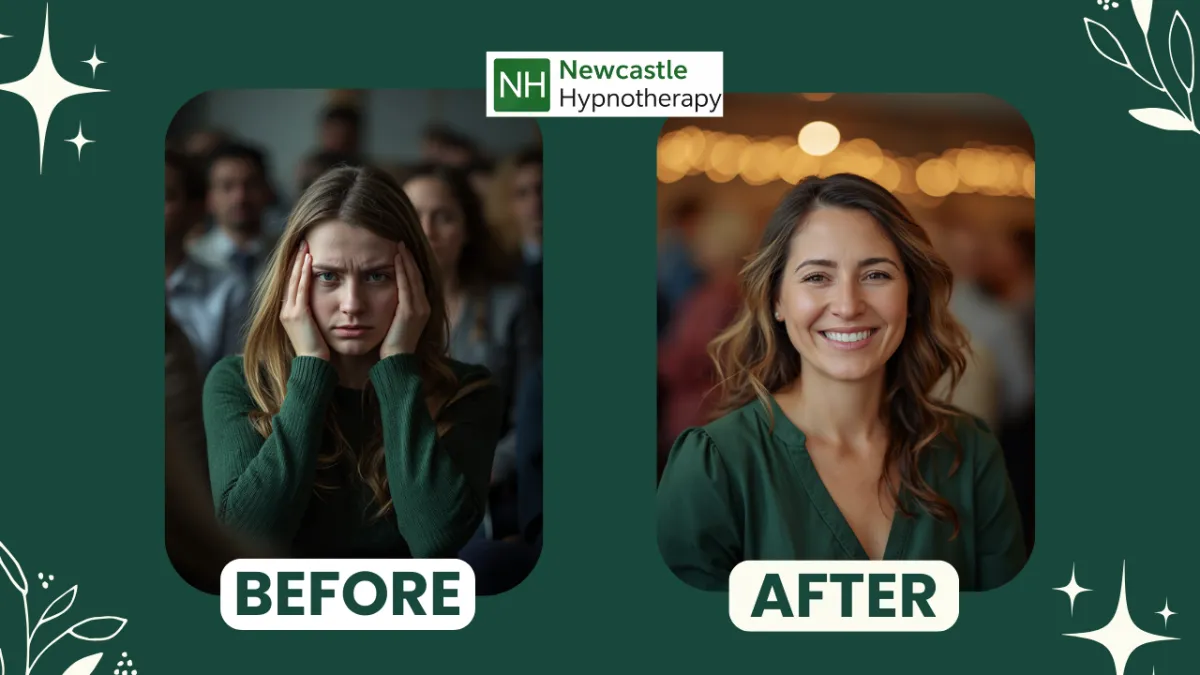
Newcastle Hypnotherapy Therapy For Social Anxiety
The First Step
If you are a professional in Newcastle carrying social anxiety and you have recognised yourself in this article, the most important thing to understand is that this is not who you are. It is a pattern. And patterns can be changed.
A free 30-minute assessment call with Mark Morley is the first step. In that conversation, you will understand exactly what is driving your social anxiety, what the programme involves, and whether working together is the right fit.
This conversation could change the next decade of your professional life.
Book your free assessment call today
Or download your free anxiety pack: practical tools for managing anxiety while you consider your next step
Frequently Asked Questions
What is social anxiety disorder? Social anxiety disorder is a persistent fear of social situations in which the person may be observed and negatively evaluated. It is one of the most common anxiety disorders, with lifetime prevalence rates of up to 12%. It is different from shyness or introversion and is characterised by significant distress and functional impairment.
Is social anxiety common in professionals? Yes. Social anxiety is particularly prevalent in professional environments and is particularly hidden, because high-achieving professionals are often skilled at masking it through performance. Many professionals carry social anxiety for years without seeking help, often because the nature of the condition makes disclosure feel threatening.
Can hypnotherapy treat social anxiety? Yes. Clinical hypnotherapy is highly effective for social anxiety because it works at the unconscious level where the anxiety pattern is stored, rather than at the conscious level where CBT and talking therapies operate. Combined with NLP, it addresses the pattern at its root and produces faster, deeper results than either approach alone.
How many sessions does it take to treat social anxiety with hypnotherapy? Most clients at Newcastle Hypnotherapy see significant improvement within 3 to 6 sessions. The exact number depends on the history and nature of the anxiety, which is assessed in the initial free consultation.
Is social anxiety the same as shyness? No. Shyness is a personality trait involving tentative feelings in unfamiliar situations. Social anxiety is a clinical condition that generates significant distress across a wide range of social situations and does not resolve with familiarity and time the way shyness does.
Where is Newcastle Hypnotherapy based? Newcastle Hypnotherapy is based at a professional business centre, Dobson House, in Gosforth, Newcastle upon Tyne. Mark also works with clients across Gateshead, Sunderland, Northumberland, Durham, and online.
Book your free assessment call here.
Learn more about anxiety treatment at Newcastle Hypnotherapy
Download your free anxiety pack
Read: Anxiety Treatment in Newcastle: Your Complete Guide
Read: Why Successful People Struggle With Anxiety
Read: Hypnotherapy vs CBT for Anxiety
Mark Morley is an award-winning Clinical Hypnotherapist, Master Practitioner of NLP, and Nutritional Coach based in Gosforth, Newcastle upon Tyne. Newcastle Hypnotherapy specialises in anxiety, stress, and confidence for professionals and business owners across Newcastle, the North East, and online. 90-plus five-star Google reviews. Over a decade of full-time clinical practice.