Hypnotherapy vs CBT for Anxiety: What is the Difference and Which Works Faster?
By Mark Morley | Newcastle Hypnotherapy | Clinical Hypnotherapist, Master NLP Practitioner and Nutritional Coach
If you are looking for help with anxiety in Newcastle, there is a good chance you have already come across two options: CBT (Cognitive Behavioural Therapy) and hypnotherapy. You may have tried one already. You may be trying to decide between them. You may have been told by your GP that CBT is the gold standard and be wondering whether hypnotherapy is a serious alternative or something less credible.
This article gives you an honest, thorough comparison of both approaches. It explains how each one works, what the research says, where each one falls short, and why the most effective treatment for anxiety is neither one alone.
Find out how we treat anxiety at Newcastle Hypnotherapy https://www.newcastle-hypnotherapy.com/anxiety-treatment-newcastle
What is CBT and How Does it Work for Anxiety?
Cognitive Behavioural Therapy was developed in the 1960s by Dr Aaron Beck and has become the most widely recommended psychological treatment for anxiety in the UK. It is sometimes available on the NHS, backed by a substantial body of research, and genuinely helpful for a significant proportion of people.
CBT is built on the idea that thoughts, feelings, and behaviours are connected. Anxiety is driven, in this model, by distorted or unhelpful thinking patterns. If you can identify those patterns, challenge them, and replace them with more balanced thinking, the emotional and physical symptoms of anxiety mayreduce as a result.
In practice, CBT for anxiety involves learning to recognise anxious thought patterns, using techniques to question and challenge those thoughts, gradually exposing yourself to feared situations in a controlled way, and practising coping strategies between sessions.
For mild to moderate anxiety, particularly anxiety that is relatively recent and tied to specific situations or thought patterns, CBT may produce good results. It is structured, time-limited, and teaches skills that clients can continue to use independently after therapy ends.
Where CBT Falls Short
CBT's limitations become apparent when anxiety is deeply rooted, long-standing, or driven by unconscious patterns that are not accessible through conscious reasoning.
The fundamental model of CBT assumes that changing thoughts changes feelings. For many people with anxiety, this is simply not how it works. They can identify the anxious thought. They can see that it is disproportionate. They can produce a more balanced alternative. And then they feel the anxiety anyway.
This is not a personal failure. It is a neurological reality. Anxiety does not live in the conscious, reasoning mind. It lives in the unconscious, in the limbic system and nervous system, where automatic threat responses are stored and triggered far faster than conscious thought can intervene.
Talking about anxiety, understanding it, and reasoning with it are all conscious processes. They operate at a level that is separate from where the anxiety is actually generated. You can become very good at CBT techniques and still feel just as anxious, because the source has not been addressed.
This is the experience of many professionals who come to Newcastle Hypnotherapy. They have completed courses of CBT. They understand their anxiety well. Their anxiety is unchanged.
Read client stories from professionals who found a different approach -- https://www.newcastle-hypnotherapy.com/newcastle-hypnotherapy-reviews
What is Hypnotherapy and How Does it Work for Anxiety?
Clinical hypnotherapy works at a fundamentally different level to CBT. Rather than working with the conscious mind, it works with the unconscious mind directly, which is where anxiety patterns are actually stored.
In a hypnotic state, the critical, analytical part of the conscious mind becomes quieter. This creates a window of access to the unconscious, during which a skilled clinical hypnotherapist can communicate directly with the patterns, associations, and automatic responses that are generating the anxiety.
This is not sleep. It is not a loss of control. You remain aware and in charge throughout. The hypnotic state is a naturally occurring experience, similar to the focused absorption you feel when completely engaged in a task, or the drifting state just before sleep. What makes it therapeutically powerful is that it allows the therapist to work at the level where the anxiety is actually programmed.
The hypnotherapy process for anxiety typically involves inducing a relaxed, focused hypnotic state, working directly with the unconscious patterns driving the anxiety, using positive suggestion and visualisation to begin establishing new automatic responses, and supporting the nervous system to reset its default from threat to calm.
Because the work is happening at the source of the anxiety rather than at the surface, clients often experience significant and rapid change, sometimes after just a handful of sessions.
What Does the Research Say?
The research comparing hypnotherapy and CBT for anxiety is genuinely interesting, and it points in a clear direction.
A landmark meta-analysis published in the Journal of Consulting and Clinical Psychology examined studies comparing CBT alone against CBT combined with hypnosis. The findings showed that the average client receiving cognitive behavioural hypnotherapy benefited more than at least 70% of clients receiving the same treatment without hypnosis.
The National Council for Hypnotherapy, one of the UK's largest professional bodies for hypnotherapists, references further research showing that for between 70 and 90% of subjects, on average, hypnosis added to the effects of CBT.
A 2024 review published in Frontiers in Psychology examined the evidence on hypnosis and anxiety and found that the review of the evidence suggests that hypnosis and hypnotherapy are effective in treating anxiety and may positively affect the cardiovascular system, reducing sympathetic activation.
A broad meta-analysis covering 20 years of hypnosis research found that among clinical practitioners, seven applications of hypnosis were rated as highly effective by at least 70% of respondents, with stress reduction, anxiety, and enhancing confidence among them.
The picture that emerges from the research is consistent: hypnotherapy works for anxiety, and when it is combined with other evidence-based approaches, outcomes are better than either approach alone.
Why Combining Hypnotherapy and CBT Principles Works Better Than Either Alone
The most important thing the research reveals is not that hypnotherapy beats CBT or that CBT beats hypnotherapy. It is that combining unconscious-level work with conscious-level work produces better outcomes than either approach on its own.
CBT teaches you to understand and manage your anxiety at the conscious level. Hypnotherapy works on the unconscious root. Together, they address anxiety from every angle simultaneously: the thinking patterns, the automatic responses, the nervous system programming, and the deep emotional drivers.
At Newcastle Hypnotherapy, Mark Morley and the team integrate clinical hypnotherapy with NLP (Neuro-Linguistic Programming) and, where relevant, nutritional therapy. This approach goes further than either CBT or standard hypnotherapy alone.
NLP works on the specific structure of the anxiety pattern, identifying how it is triggered, how it runs, and how the sequence can be interrupted and rebuilt. It produces rapid practical results in real-world situations, so clients gain immediate tools to use in meetings, presentations, or any situation that previously triggered anxiety.
Nutritional therapy addresses what almost every other anxiety treatment ignores entirely: the physiological drivers of anxiety. The gut produces the vast majority of the body's serotonin. Inflammation, blood sugar instability, food intolerances, and nutritional deficiencies all directly amplify anxiety and stress responses. Addressing these factors alongside the psychological work produces outcomes that psychological treatment alone cannot achieve.
[Download the free anxiety pack to understand more about how anxiety works -- https://www.newcastle-hypnotherapy.com/free-anxiety-relief-pack-newcastle-hypnotherapy
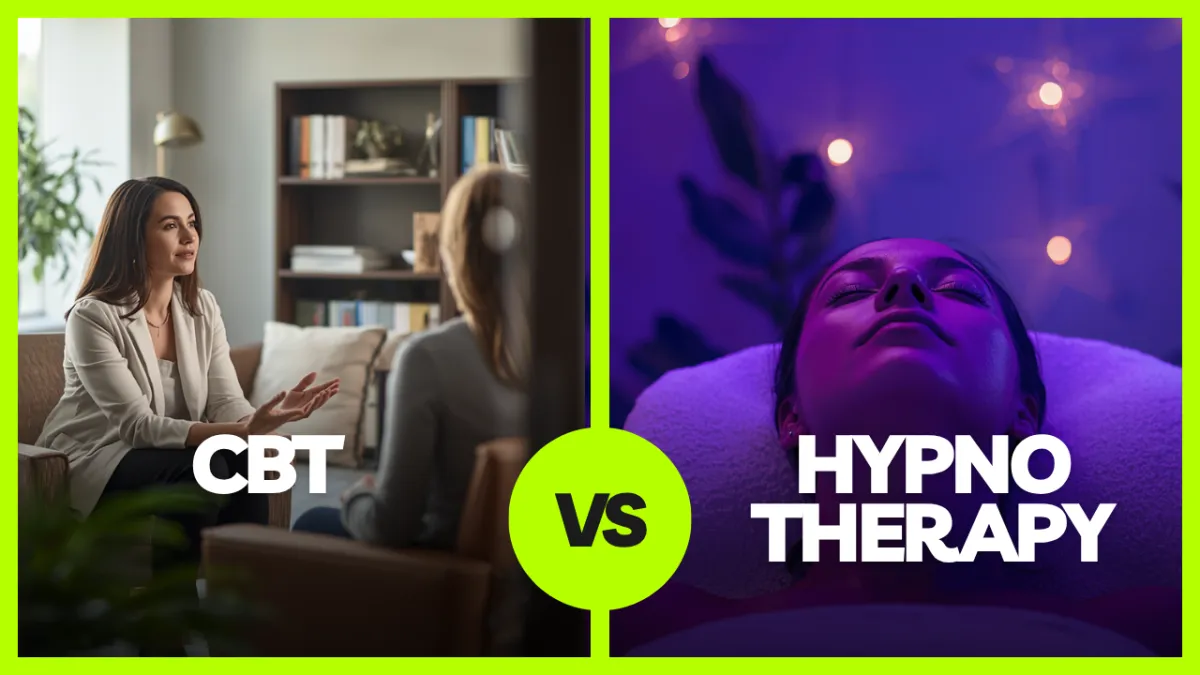
Hypnotherapy vs CBT: A Direct Comparison
How it works
CBT works at the conscious level, targeting thought patterns and behaviours. Hypnotherapy works at the unconscious level, targeting the automatic patterns and responses that generate anxiety before conscious thought intervenes.
Speed of results
CBT typically involves 6 to 20 sessions on the NHS, with results developing gradually over that period. Hypnotherapy combined with NLP often produces significant results within 3 to 6 sessions, because the work is addressing the source rather than the symptom.
Suitability
CBT is well-suited to mild anxiety that is relatively recent and tied to identifiable thought patterns. Hypnotherapy and NLP are particularly effective for deeper-rooted anxiety, anxiety that has persisted despite CBT, and anxiety with a strong automatic or physical component.
NHS availability
CBT is available on the NHS with a referral, though waiting times can be significant, often 9 months or more. Hypnotherapy is a private treatment. The investment reflects both the quality of the therapy and the speed of results.
Long-term outcomes
Both approaches can produce lasting results when done well. Hypnotherapy that addresses the unconscious root of anxiety, rather than just the surface symptoms, tends to produce change that does not require ongoing maintenance.
Who delivers it
CBT is delivered by either trained or trainee psychologists, psychotherapists, and CBT therapists, many of whom work within NHS services. Hypnotherapy is delivered by clinical hypnotherapists, a profession that is unregulated in the UK, which makes choosing an experienced, properly qualified practitioner essential.
Read our guide to choosing the right hypnotherapist in Newcastle -- https://www.newcastle-hypnotherapy.com/post/choosing-a-hypnotherapist-newcastle
The Question Most People Are Really Asking
When people search for hypnotherapy vs CBT, they are usually not asking a purely academic question. They are asking: I have been struggling with anxiety, and I want to know what will actually work for me.
The honest answer is that both approaches have genuine value. CBT has helped millions of people and should not be dismissed. But for professionals who have already tried CBT without lasting results, or whose anxiety is deep-rooted and persistent, hypnotherapy combined with NLP and nutritional therapy offers something that CBT structurally cannot: direct access to the unconscious patterns that are generating the anxiety, and the ability to change them at the source.
The professionals and business owners who come to Newcastle Hypnotherapy typically come having already done the talking. They have understood their anxiety. They have developed coping strategies. They are still anxious. What they need is not more conscious-level work. They need something that reaches deeper.
That is what clinical hypnotherapy, NLP, and nutritional therapy do together.
What Happens If You Have Already Tried CBT
If you have already completed a course of CBT for anxiety and you are still struggling, you are not alone, and you are not a lost cause. It means that the approach you used addressed the parts of your anxiety that CBT can reach. It means there are layers it did not reach.
Those layers are exactly where hypnotherapy and NLP work. Most of our most successful clients came to us having already done CBT, sometimes multiple times. For them, the combination approach produced results they had stopped believing were possible.
If that is where you are, the first step is a conversation. A free 30-minute assessment call with Mark Morley will help you understand exactly what is driving your anxiety, why previous approaches may not have worked, and what working together would involve.
Book your free anxiety assessment call today -- https://assessment.newcastle-hypnotherapy.com/
Frequently Asked Questions
Is hypnotherapy better than CBT for anxiety? For many people, particularly those whose anxiety has persisted despite CBT, hypnotherapy produces faster and deeper results because it works at the unconscious level where anxiety is actually stored. The most effective approach combines hypnotherapy, NLP, and, where relevant, nutritional therapy, addressing anxiety on every level simultaneously.
How many sessions of hypnotherapy do I need for anxiety? Most clients at Newcastle Hypnotherapy see significant improvement within 3 to 6 sessions. Some clients, like Marie, a Newcastle professional who documented her experience, are anxiety-free within three weeks. A single session is not sufficient for lasting resolution of anxiety, regardless of what some practitioners claim.
Can I have both hypnotherapy and CBT? Yes. The research actually shows that combining hypnosis with CBT principles produces better outcomes than either alone. At Newcastle Hypnotherapy, the approach integrates multiple modalities, including hypnotherapy, NLP, and nutritional therapy, to address anxiety from every angle.
Why has CBT not worked for me? CBT works at the conscious level. If your anxiety has a strong unconscious component, which most persistent anxiety does, CBT will help you understand it and manage it, but may not resolve it. Hypnotherapy works at the level that CBT cannot reach.
Is hypnotherapy available on the NHS in Newcastle? Hypnotherapy is not currently available on the NHS. It is a private treatment. CBT is available on the NHS through your GP, though waiting times are long. Many clients choose to invest in private hypnotherapy because the results are faster and more complete than NHS CBT waiting lists allow.
Where is Newcastle Hypnotherapy based? Newcastle Hypnotherapy is based at a professional business centre, Dobson House in Gosforth, Newcastle upon Tyne. Mark and the team also work with clients across Gateshead, Sunderland, Northumberland, Durham, and online.
Book your free assessment call with Mark Morley -- https://assessment.newcastle-hypnotherapy.com/
Learn more about anxiety treatment at Newcastle Hypnotherapy -- https://www.newcastle-hypnotherapy.com/anxiety-treatment-newcastle
Download your free anxiety relief pack -- https://www.newcastle-hypnotherapy.com/free-anxiety-relief-pack-newcastle-hypnotherapy
Read: How to Choose the Right Hypnotherapist in Newcastle -- https://www.newcastle-hypnotherapy.com/post/anxiety-free-in-3-weeks-a-newcastle-professionals-story-newcastle-hypnotherapy
Mark Morley is an award-winning Clinical Hypnotherapist, Master Practitioner of NLP, and Nutritional Coach based in Gosforth, Newcastle upon Tyne. Newcastle Hypnotherapy specialises in anxiety, stress, and confidence for professionals and business owners across Newcastle, the North East, and online. 90-plus five-star Google reviews. Over a decade of full-time clinical practice.