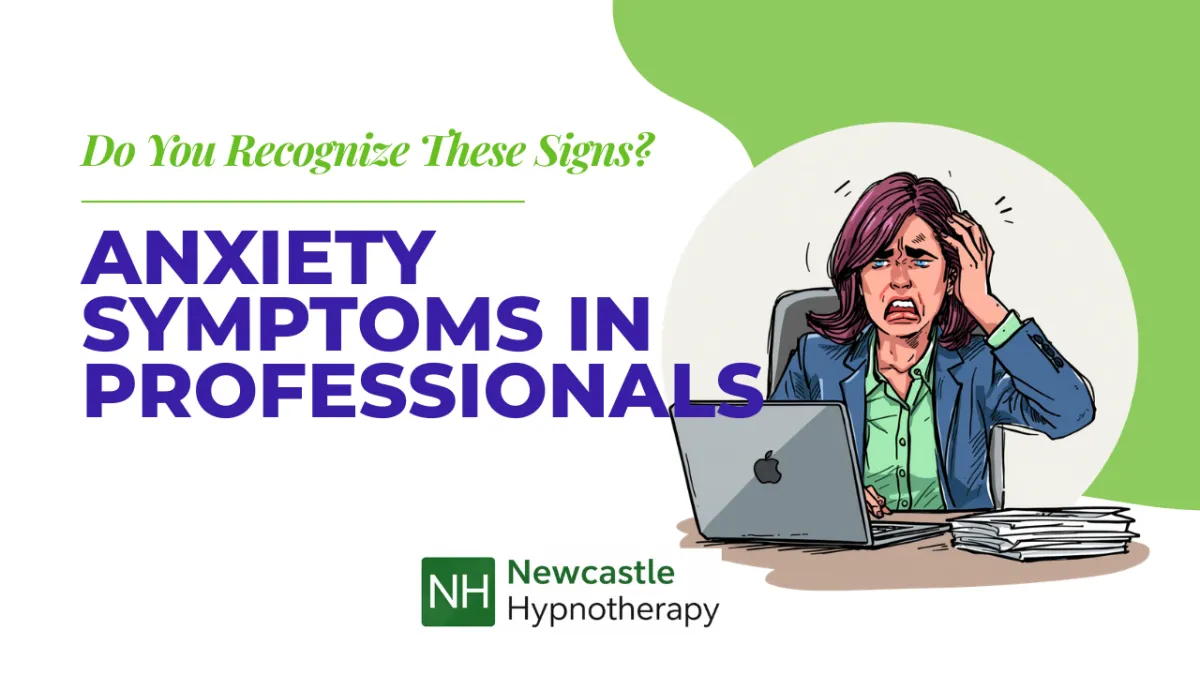
Anxiety Symptoms in Professionals: When Stress Becomes Something More
By Mark Morley | Newcastle Hypnotherapy | Clinical Hypnotherapist, Master NLP Practitioner and Nutritional Coach
Most professionals who come to us at Newcastle Hypnotherapy do not arrive saying they have anxiety.
They arrive saying they are stressed. They are exhausted. They cannot switch off. They are snapping at people they care about. They are lying awake at 3am running through tomorrow's problems. They feel on edge in situations they used to handle without a second thought.
They have usually been telling themselves for months, sometimes years, that this is just what it is like at their level. That high performers feel this way. That it will ease off when the project is done, when the quarter ends, when things slow down.
Things do not slow down. And what they are feeling is not just stress.
According to the Health and Safety Executive's 2024 annual report, work-related stress, depression, and anxiety account for 17.1 million working days lost annually in the UK, representing 50% of all work-related ill health cases. Professional services, healthcare, education, and financial services report the highest levels of work-related stress, with employees in these sectors 40% more likely to experience chronic stress symptoms.
You are not alone. But being common does not make it acceptable. And it certainly does not mean you have to keep carrying it.
Find out how we help professionals overcome anxiety at Newcastle Hypnotherapy -- https://www.newcastle-hypnotherapy.com/anxiety-treatment-newcastle
The Professional Anxiety Problem Nobody Talks About
There is a particular kind of anxiety that flourishes in professional environments, and it is one that rarely gets named for what it is.
It is not the anxiety that stops you from functioning. It is not panic attacks on the floor or an inability to leave the house. It is the anxiety that lives alongside high performance, the kind that drives you to over-prepare, over-check, over-deliver, and over-think. The kind that looks like conscientiousness from the outside and feels like exhaustion from the inside.
776,000 UK workers reported work-related stress, depression or anxiety in 2024, representing nearly half of all reported work-related ill health cases. But that number only captures the people who reported it. The professionals who are quietly managing it, pushing through it, and telling nobody represent a far larger group.
Less than half of employees who suffer from workplace stress have talked to their employers about it. For professionals and business owners, that number is likely even lower. The higher you are, the less safe it feels to admit you are struggling.
This silence has a cost. And the first step in doing something about it is recognising what you are actually dealing with.
The Difference Between Stress and Anxiety
Stress and anxiety are related, but they are not the same thing, and understanding the difference matters because the treatment for each is different.
Stress is a response to external pressure. It is proportionate, it is tied to a specific situation, and it resolves when the situation resolves. Stress before a big presentation, stress during a difficult negotiation, stress when you are under-resourced and over-committed, all of these are normal responses to real demands. They are unpleasant but they are functional.
Anxiety is different. Anxiety is a response that has become detached from any specific external cause. It is a pattern running in the background of your nervous system, generating a low-level or sometimes high-level state of threat that does not switch off when the stressor is removed.
You can recognise the difference by asking yourself a simple question. When the thing that is worrying you is resolved, do you feel genuinely at ease? Or does the worry simply move to the next thing, and then the next, in an endless loop that never fully quietens?
If the worry moves rather than resolves, that is anxiety.
Anxiety Symptoms in Professionals: What to Look For
Because professional anxiety so often presents as productivity, drive, and high standards rather than visible distress, it is frequently missed, minimised, or misattributed to personality.
These are the symptoms that professionals most commonly describe when they come to us. They do not all need to apply to you for anxiety to be a factor.
Physical symptoms
Persistent tension in the shoulders, neck, jaw, or chest. A racing heart or palpitations, particularly before meetings, calls, or challenging situations. Shallow breathing or the sense of not being able to take a full breath. Fatigue that does not resolve with sleep. Disrupted sleep, particularly waking in the early hours, with a mind that will not stop. Digestive problems, including nausea, stomach tension, or irritable bowel symptoms. Headaches that arrive regularly without a clear physical cause. A general sense of physical unease or being permanently braced.
Mental and cognitive symptoms
Difficulty concentrating or completing tasks that used to feel straightforward. Overthinking decisions that previously felt easy. Difficulty letting go of mistakes or imagined future problems. The inability to be fully present in a conversation, meeting, or moment because part of your mind is elsewhere. A running commentary of self-doubt or self-criticism that sits beneath the surface of everything you do. Difficulty relaxing even when you have the time. Catastrophising, jumping automatically to worst-case scenarios.
Emotional symptoms
Irritability that feels disproportionate to its trigger. A short fuse with people you care about. A sense of emotional flatness or numbness alongside high output. Feeling detached from work that used to feel meaningful. Dread before situations that used to feel manageable. A persistent undercurrent of unease that you cannot pin to anything specific.
Behavioural symptoms
Over-preparing for meetings, calls, and presentations beyond what is genuinely needed. Avoiding situations, conversations, or decisions that trigger discomfort. Checking and re-checking work, emails, and communications. Difficulty delegating because of a persistent sense that things will not be done well enough. Working excessive hours not because the workload requires it but because stopping feels unsafe. Using alcohol, food, exercise, or other behaviours to manage the emotional state rather than address it.
Why Professionals Are Particularly Vulnerable
Anxiety does not discriminate by salary or seniority, but the professional environment creates conditions that make anxiety more likely and more difficult to resolve.
High stakes and constant scrutiny. The higher you go, the more decisions matter and the more visible you are. The nervous system responds to perceived threat, and professional life at a senior level creates a sustained environment of threat perception that keeps the anxiety response permanently activated.
The identity trap. For many professionals and business owners, performance is identity. Feeling anxious threatens not just your comfort but your sense of who you are. This makes it harder to acknowledge and harder to seek help for.
The competence paradox. The more capable you are, the more you can mask anxiety through performance. You become skilled at appearing composed while feeling anything but. This masks the problem from others and often from yourself, delaying recognition and treatment.
The always-on culture. 68% of UK workers report difficulty maintaining boundaries between work and personal life. For professionals and business owners, this is even more acute. When work is always accessible, the nervous system never fully leaves alert mode. Rest becomes structurally impossible and anxiety fills the space that recovery should occupy.
Download your free anxiety relief pack: practical tools for professionals managing anxiety right now -- https://www.newcastle-hypnotherapy.com/free-anxiety-relief-pack-newcastle-hypnotherapy
When Stress Becomes Something More: The Warning Signs
Stress that is not addressed does not simply plateau. It compounds. Over time, sustained stress reshapes the nervous system, lowering the threshold at which the anxiety response is triggered and making the recovery period after each episode shorter.
These are the signs that what you are experiencing has moved beyond manageable stress into something that needs proper attention:
The anxiety is present even when there is no obvious external cause. You feel on edge on a Sunday evening. You feel dread before ordinary conversations. You feel a background hum of worry that you cannot tie to anything specific.
The physical symptoms are persistent. Tension, sleep disruption, fatigue, or digestive symptoms that have been present for weeks or months rather than days, and that do not fully resolve with rest or holidays.
Your coping strategies are no longer working. The run that used to clear your head no longer clears your head. The glass of wine that used to take the edge off now needs to be two or three. The weekend that used to recharge you no longer touches the tiredness.
It is affecting relationships. The people closest to you are receiving the version of you that is left after the anxiety has taken what it needs. Shortened patience, emotional unavailability, withdrawal.
You are beginning to avoid things. Situations, decisions, conversations, or opportunities that you would previously have engaged with without hesitation are now being sidestepped.
You are thinking about it all the time. Not just when triggers are present but persistently, in the background, as a constant low-level presence that colours everything.
If three or more of these apply, you are not just stressed. You are dealing with anxiety. And it is worth dealing with properly.
Why This Does Not Resolve on Its Own
One of the most common things professionals tell us when they eventually make contact is that they kept waiting for things to ease off. For the busy period to end. For the workload to be reduced. For something external to change.
Anxiety does not work like that. It is not a response to external circumstances. It is a pattern embedded in the nervous system. External circumstances can trigger it and amplify it, but they do not create it, and removing the trigger does not resolve the pattern.
This is why taking a holiday provides temporary relief but not lasting change. Why the anxiety returns within days of getting back. Why you can remove every stressor from your environment and still feel anxious.
The pattern has to be addressed directly, at the level where it lives: in the unconscious mind and nervous system.
That is exactly what clinical hypnotherapy and NLP do. Not managing anxiety. Not coping with anxiety. Resolving it.
Read: Hypnotherapy vs CBT for Anxiety - What is the Difference and Which Works Faster -- https://www.newcastle-hypnotherapy.com/post/hypnotherapy-vs-cbt-for-anxiety-newcastle
What Resolving Anxiety Actually Looks Like
Many professionals come to us having accepted, somewhere along the way, that this is just how they are. That they are an anxious person. That high anxiety is the price of high performance.
It is not. It is a pattern. And patterns can be changed.
Marie is a professional based in Newcastle. She came to us carrying anxiety that had been with her for years. She had tried other approaches. Nothing had lasted. Three weeks after beginning work with Mark Morley at Newcastle Hypnotherapy, she was anxiety-free. She sat on camera and said so, because she wanted other professionals to know it was possible.
[Read Marie's full story here -- LINK TO MARIE BLOG]
Her experience is not unusual. It is what happens when anxiety is treated at the right level, by an experienced practitioner, using an approach that combines clinical hypnotherapy, NLP, and where relevant, nutritional therapy, to address the psychological, neurological, and physiological dimensions of anxiety simultaneously.
The professionals and business owners who work with Mark Morley at Newcastle Hypnotherapy do not come back because the anxiety has gone. They refer others, because what happened for Marie happens consistently.
The First Step
If you have read this article and recognised yourself in it, the most useful thing you can do is have a conversation.
Not a commitment. Not a long intake process. A free 30-minute assessment call with Mark Morley, in which you will understand exactly what is driving your anxiety, why it has persisted, and what resolving it properly would involve.
Most people who take that call leave it with more clarity about their anxiety than they have had in years.
[Book your free assessment call today -- LINK TO ASSESSMENT CALL PAGE]
Or if you would like to start with something practical right now:
[Download the free anxiety pack: tools for professionals who are ready to take the first step -- LINK TO FREE ANXIETY PACK]
Frequently Asked Questions
How do I know if I have anxiety or just stress? Stress is tied to a specific external cause and resolves when that cause is removed. Anxiety is a pattern that persists regardless of external circumstances, moving from one worry to the next rather than resolving. If your worry moves rather than resolves, that is anxiety.
Can anxiety affect high-performing professionals? Yes. Professional anxiety is extremely common and frequently goes unrecognised because it presents as drive, conscientiousness, and high standards rather than visible distress. Being high-functioning does not protect against anxiety. In many cases it masks it.
What are the physical symptoms of anxiety in professionals? The most common physical symptoms are sleep disruption, persistent muscular tension, fatigue, digestive problems, headaches, and a racing or irregular heartbeat. Many professionals attribute these to overwork rather than anxiety, which delays recognition and treatment.
How long does anxiety take to treat with hypnotherapy? Most clients at Newcastle Hypnotherapy see significant improvement within 3 to 6 sessions. Some, like Marie, a Newcastle professional who documented her experience, are anxiety-free within three weeks. The exact timeline depends on the nature and history of the anxiety, which is assessed in the initial call.
Do I need a GP referral to see a hypnotherapist in Newcas
tle? No. You can book directly. The first step is a free assessment call with Mark Morley to understand your anxiety and whether the programme is right for you. No referral is required.
Where is Newcastle Hypnotherapy based? Newcastle Hypnotherapy is based at a professional business centre in Gosforth, Newcastle upon Tyne. Mark also sees clients from across Gateshead, Sunderland, Northumberland, Durham, and online.
Book your free assessment call -- https://assessment.newcastle-hypnotherapy.com/
Learn more about anxiety treatment at Newcastle Hypnotherapy -- https://www.newcastle-hypnotherapy.com/anxiety-treatment-newcastle
Download your free anxiety pack -- https://www.newcastle-hypnotherapy.com/free-anxiety-relief-pack-newcastle-hypnotherapy
More Newcastle Hypnotherapy Anxiety Blog Articles:
Can Newcastle Hypnotherapy Help Social Anxiety? A 10 Year Track Record Says Yes
How Long Does Anxiety Therapy Take in Newcastle? Realistic Timelines Explained
Mark Morley is an award-winning Clinical Hypnotherapist, Master Practitioner of NLP, and Nutritional Coach based in Gosforth, Newcastle upon Tyne. Newcastle Hypnotherapy specialises in anxiety, stress, and confidence for professionals and business owners across Newcastle, the North East, and online. 90-plus five-star Google reviews. Over a decade of full-time clinical practice.