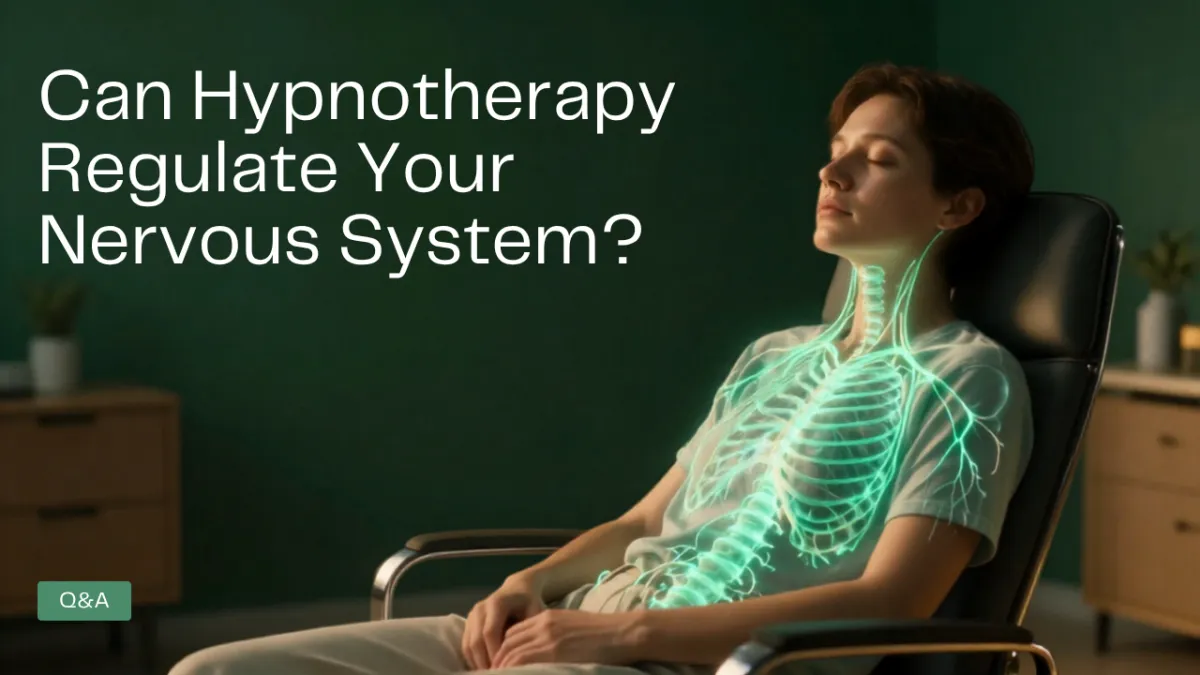
Can Hypnotherapy Regulate Your Nervous System? Your Questions Answered
As nervous system regulation becomes one of the biggest conversations in mental health and wellness in 2026, many people are asking: where does hypnotherapy fit in? If you've been curious about whether hypnotherapy could genuinely help calm an anxious nervous system, here are the answers to the questions we hear most.
Learn about Nervous System Regulation for Anxiety Disorders.
What is the connection between hypnotherapy and nervous system regulation?
Hypnotherapy works directly with the subconscious mind — the part of your brain that runs your automatic responses, including your stress and anxiety reactions. When you're in a hypnotic state, your brainwaves slow to alpha or theta frequencies, and your body naturally shifts into the parasympathetic (rest-and-digest) state. This is the same state your nervous system needs to be in to heal, reset, and regulate.
Put simply: every session of hypnotherapy is also a session of nervous system regulation. You're not just changing your thinking — you're giving your body a direct experience of deep calm, and over time, that calm becomes the new normal.
Why doesn't just "thinking positively" calm anxiety?
This is one of the most important questions we get at Newcastle Hypnotherapy. The answer lies in how anxiety works.
Anxiety is not primarily a thinking problem — it's a nervous system problem. The anxious response is generated in the limbic system (your emotional brain) and the body, faster than the thinking brain can intercept. By the time you consciously notice you're anxious, your body is already in fight-or-flight mode.
Hypnotherapy bypasses the critical, conscious mind and works directly at the level where anxiety is created — the subconscious. This is why it can produce changes that cognitive approaches alone sometimes can't reach.
What happens to the nervous system during a hypnotherapy session?
During hypnosis, several measurable things happen in the body:
Heart rate slows
Blood pressure decreases
Cortisol (the primary stress hormone) reduces
Brainwave activity shifts from beta (alert, anxious) to alpha or theta (calm, receptive)
The parasympathetic nervous system becomes dominant
This is not relaxation as a side effect — it's nervous system regulation as the mechanism of change. The therapeutic work happens precisely because the nervous system is in this regulated state.
Can hypnotherapy help with anxiety specifically?
Yes — anxiety is one of the conditions hypnotherapy is most consistently effective for, and it's the primary focus of our work here in Newcastle.
Whether you experience generalised anxiety, social anxiety, panic attacks, health anxiety, or anxiety that shows up as physical symptoms (tension, IBS, insomnia, heart palpitations), the underlying mechanism is the same: a nervous system stuck in overdrive.
Hypnotherapy helps by:
Identifying and resolving the root causes and triggers stored in the subconscious
Breaking the habitual anxiety response patterns
Replacing them with calm, resourceful responses at a deep, automatic level
Giving your body repeated experiences of safety and calm that retrain the nervous system over time
You can learn more about how we work on our anxiety treatment Newcastle page.
How is hypnotherapy different from meditation or breathwork for nervous system regulation?
Meditation and breathwork are excellent tools — and we often recommend them alongside hypnotherapy. But there are some key differences:
Meditation and breathwork are practices you do regularly to build regulation over time. They work at a conscious level, helping you notice and manage your state in the moment.
Hypnotherapy works at a subconscious level to change the patterns generating the dysregulation in the first place. It's less about managing anxiety and more about resolving it at the root.
Think of it this way: breathwork helps you get off a runaway train. Hypnotherapy changes the track it's running on.
How many sessions does it take to regulate the nervous system through hypnotherapy?
This depends on the individual, the nature of their anxiety, and how long it's been present. Some clients notice significant shifts after two or three sessions. For deeper or longer-standing anxiety, a short programme of six to eight sessions is often recommended.
Unlike some therapies that can take years, hypnotherapy is known for producing meaningful results in a relatively short time — because it works with the subconscious directly rather than trying to override it consciously.
Is hypnotherapy safe for nervous system regulation?
Yes. Clinical hypnotherapy carried out by a qualified practitioner is a safe, non-invasive approach. You remain in control throughout, you cannot be made to do anything against your will, and you will always remember what happens in a session.
For people with anxiety, it's worth knowing that hypnotherapy is one of the gentlest therapeutic approaches available. There's no reliving of trauma in a distressing way — the work is done in a calm, supported state where you feel safe throughout.
Where can I start if I'm interested in hypnotherapy for anxiety in Newcastle?
If you're in Newcastle or the North East and you're ready to explore how hypnotherapy can help regulate your nervous system and reduce your anxiety, there are two great starting points:
Download our Free Anxiety Relief Pack — a collection of practical tools and techniques you can use straight away to start calming your nervous system: get your free pack here.
Find out more about anxiety treatment — visit our anxiety treatment Newcastle page to understand how we work and take the first step towards booking a session.
Your nervous system learned to be anxious. With the right support, it can learn something different.
Health Anxiety Case Study: How Jennifer Stopped Constantly Checking Her Body in Just 5 Weeks
How to Get Rid of Severe Anxiety: Why a Specialist Gets Results in Weeks, Not Months