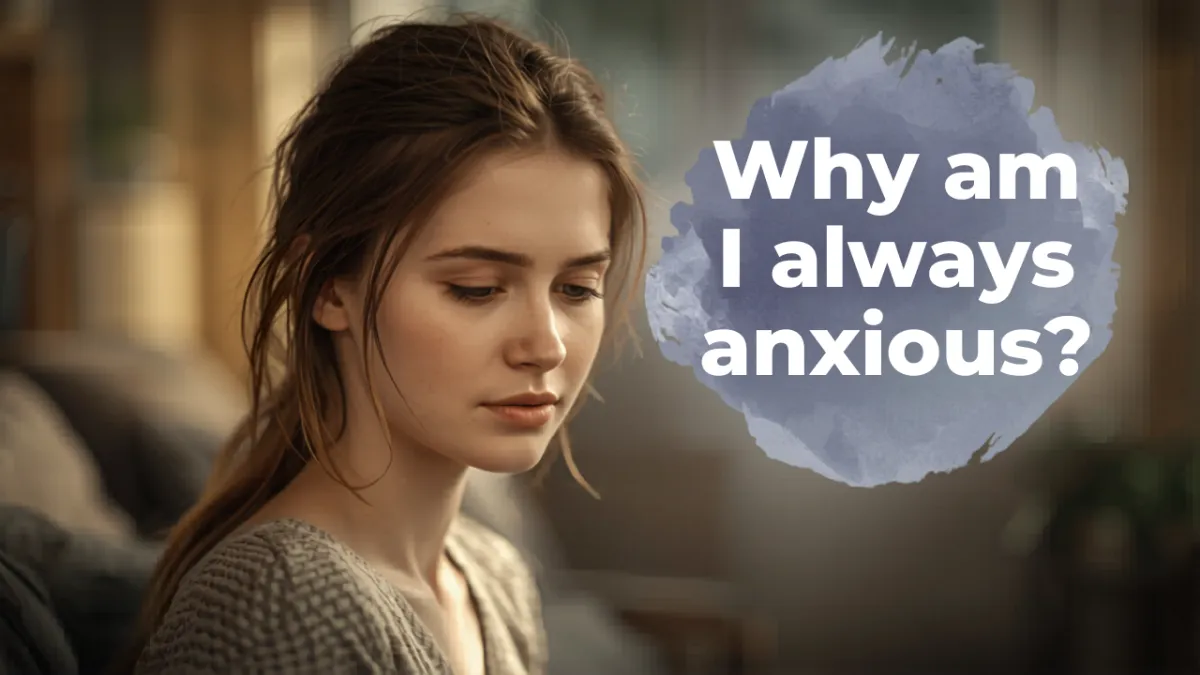
Why Do I Feel Anxious All the Time?
If this is a question you find yourself asking, I want to start with something important: you are not broken, and you are not weak. There is a very specific reason your mind and body have settled into a state of almost constant anxiety, and once you understand it, the path forward becomes a lot clearer.
I have worked with thousands of people across Newcastle and the North East who have lived with chronic anxiety for years, often decades, without ever fully understanding why it will not switch off. This article explains what is actually happening, and what genuinely works to resolve it.
Newcastle Hypnotherapy's Award Winning Approach To Anxiety Treatment.
First, Anxiety Is Not the Enemy
Let's start at the beginning. Anxiety is not a malfunction. It is one of the most sophisticated and effective survival systems ever developed. Without it, our ancestors would not have survived long enough to pass on their genes, and you would not be here reading this.
When your brain perceives a threat, real or imagined, it triggers a cascade of physical and psychological changes designed to keep you alive. Your heart rate increases. Your breathing speeds up. Your muscles tense. Your attention narrows to focus on the danger. Stress hormones flood your system. Your body is preparing to fight, flee or freeze.
In the right context, this is extraordinary. If a car pulls out in front of you, your anxiety response reacts in a fraction of a second before your conscious mind has even registered what is happening. It has saved your life more times than you realise, quietly and automatically, in the background.
The anxiety state exists for a reason. The problem is not the anxiety itself. The problem is when the system gets stuck on.
How Anxiety Becomes a Habit
Here is where most people's understanding of anxiety stops short, and where the real answer lies.
Your brain is a pattern-recognition machine. Its primary job is efficiency. Every time you experience a situation, an emotion or a physical state, your brain is quietly filing it away, building a map of the world and how to respond to it. The more a pattern is repeated, the more deeply it is encoded, and the more automatically it fires.
This is how you learned to drive, to read, to walk. You do not consciously think through each step anymore. The pattern runs automatically. The brain loves this. It frees up conscious processing power for other things.
But here is the catch: the brain does exactly the same thing with anxiety.
If you have been in a state of anxiety repeatedly, over weeks, months or years, your brain stops treating it as an emergency response and starts treating it as a default setting. It becomes the background hum of your nervous system. You wake up anxious before anything has even happened. You feel on edge in situations that are completely safe. You worry about worrying. The anxiety state has become habitual, automatic and deeply ingrained, running in the background like a programme you never chose to install.
This is not a character flaw. It is neuroscience. Your brain has learned to be anxious, and it is very good at it. The patterns are real, they are physical, they are encoded in your nervous system, and they can be changed.
So What Actually Resolves It?
If anxiety has become a habit, the solution is not to white-knuckle your way through it or talk about your feelings for months until something shifts. The solution is to interrupt the pattern, retrain the nervous system and replace the habitual anxiety state with a genuinely different default.
In my experience working with clients, the fastest and most lasting results come from a four-step process.
Step One: Recognise It Earlier
Most people only notice their anxiety when it has already taken hold. By that point it has momentum, and it is much harder to shift. The first and most important skill to develop is catching it at the very beginning of the cycle, before it builds.
This sounds simple, but it requires a level of self-awareness that most people have never been taught. In our sessions, clients learn to identify their personal early warning signals, the subtle physical sensations, the specific thought patterns, the environmental triggers that reliably precede a full anxiety response. Once you can spot the beginning of the pattern, you have a window to intervene that simply was not available to you before.
Step Two: Slow It Down
The moment you recognise the pattern starting, the next step is to interrupt its momentum. There are specific, proven techniques for doing this quickly and reliably, drawn from hypnotherapy, NLP and the emerging science of nervous system regulation. Breathing patterns, anchoring techniques, pattern interrupts, specific language you use internally about what is happening. Each of these, used at the right moment, puts the brakes on the anxiety cycle before it reaches full speed.
This is not suppression or avoidance. You are not pushing the anxiety away. You are simply changing the speed at which it runs, which changes everything that follows.
Step Three: Stop It
With the pattern slowed, you are now in a position to stop it entirely. This is where deeper work happens, addressing the specific memories, beliefs or internal representations that are fuelling the habitual anxiety response at its root. Hypnotherapy is extraordinarily effective here because it works directly at the subconscious level where the patterns are stored, rather than trying to reason with them from the outside.
NLP techniques are equally powerful for collapsing the associations and triggers that keep the anxiety cycle turning. The goal is not simply to manage anxiety better. The goal is to genuinely dismantle the pattern that is generating it.
Step Four: Step Into a Better State
This is the step that most approaches miss entirely, and it is arguably the most important one.
Removing anxiety is only half the job. Your nervous system needs something to replace it with. If you simply create a gap where the anxiety used to be, the brain will often fill it with more of the same. What we do instead is actively install the alternative state: calm, confident, grounded, clear-headed and in control. Not as a fragile coping strategy, but as a genuinely different default that becomes as automatic and habitual as the anxiety once was.
Clients who go through this full four-step process do not just learn to manage their anxiety better. They stop recognising themselves in it. It stops feeling like theirs.
Why We Use Hypnotherapy, NLP and Nutritional Coaching Together
At Newcastle Hypnotherapy, we do not rely on a single tool. Anxiety is not a single-layer problem, and the most effective approach addresses it from multiple angles simultaneously.
Hypnotherapy works directly with the subconscious mind, accessing and reprogramming the deep patterns that conscious willpower and talking therapy often cannot reach. It is fast, it is effective, and the changes it produces tend to stick because they happen at the level where the patterns actually live.
NLP (Neuro-Linguistic Programming) gives clients practical, fast-acting techniques to change the way they think, the language they use internally and the mental representations that trigger anxious responses. NLP does not take months. The right technique applied at the right moment can produce dramatic shifts in a single session.
Nutritional coaching addresses something that is routinely overlooked in anxiety treatment: the direct, well-documented relationship between what you eat and how your nervous system functions. Blood sugar instability, gut health problems, nutritional deficiencies and chronic inflammation all directly affect anxiety levels. Addressing the physical foundations of your mental health is not optional. It is part of the complete picture, and without it many people plateau at a level of improvement that never becomes full resolution.
Together, these three approaches work on the mind, the behaviour patterns and the body simultaneously. That is why our clients tend to see meaningful results within a handful of sessions, rather than months or years.
You Do Not Have to Keep Feeling Like This
If anxiety feels like your permanent state right now, I understand how exhausting and hopeless that can feel. But what I have seen, working with thousands of clients across Newcastle and the North East, is that the people who feel most stuck are often the ones who respond best once they have the right tools and support.
Your brain learned to be anxious. It can learn something different. The process is not as long or as difficult as most people expect, and the version of yourself on the other side of it is worth every step of the journey.
If you would like to talk about where you are right now and whether we can help, book a free assessment call below. No obligation, no pressure, just a conversation.
Ready to Stop Feeling Anxious All the Time?
Book a free assessment call with Mark. We will talk through what you are experiencing and map out the fastest route to feeling like yourself again.
Book Your Free Assessment Call
Or call 07568 455 809
Mark Morley is a Clinical Hypnotherapist, Master NLP Practitioner and Nutritional Therapist with over 10 years of experience helping people across Newcastle upon Tyne and the wider North East overcome anxiety, stress and the issues holding them back. Newcastle Hypnotherapy is based at Dobson House, Regent Farm Road, Gosforth, Newcastle upon Tyne NE3 3PF.
Useful Anxiety Treatment & Therapy Blog Articles.
Why the NHS Keeps Failing People with Anxiety Disorders
Does Hypnotherapy Actually Work For Anxiety? Here's What The Science Says
Anxiety Treatment in Newcastle: Your Complete Guide to Getting Help
How a Newcastle Professional Became Anxiety-Free in 3 Weeks — Marie's Story
What Happens During Your First Hypnotherapy Session for Anxiety in Newcastle