What Actually Happens in an NHS CBT Session for Anxiety (And Why It Is Not Enough)
Every year, millions of people in the UK are referred to NHS talking therapies for anxiety. Most end up in a course of CBT, cognitive behavioural therapy. But very few people actually know what to expect before they walk through the door, and even fewer come out the other side feeling like it truly worked.
This article walks through what typically happens in NHS CBT sessions for anxiety, what the approach is designed to do, and crucially, where it tends to fall short.
If you are currently on an NHS waiting list, have just finished a course of CBT, or are wondering whether there is a better route for your anxiety, this is worth reading. You can also explore our anxiety treatment page to see what a more effective alternative looks like.
How You End Up in NHS CBT
The typical route goes like this. You visit your GP, describe your anxiety, and are referred to your local IAPT service (Improving Access to Psychological Therapies). You go on a waiting list. Depending on where you live in the UK, that wait could be anywhere from a few months to around a year.
When you reach the front of the queue, you will usually have an initial assessment call or appointment. Based on what you describe, you will be assigned a level of support. Many people are placed into low-intensity support first, which often means guided self-help, essentially workbooks and occasional phone check-ins with a practitioner. Only those assessed as needing more intensive support move into face-to-face or video CBT sessions.
What Happens in a CBT Session
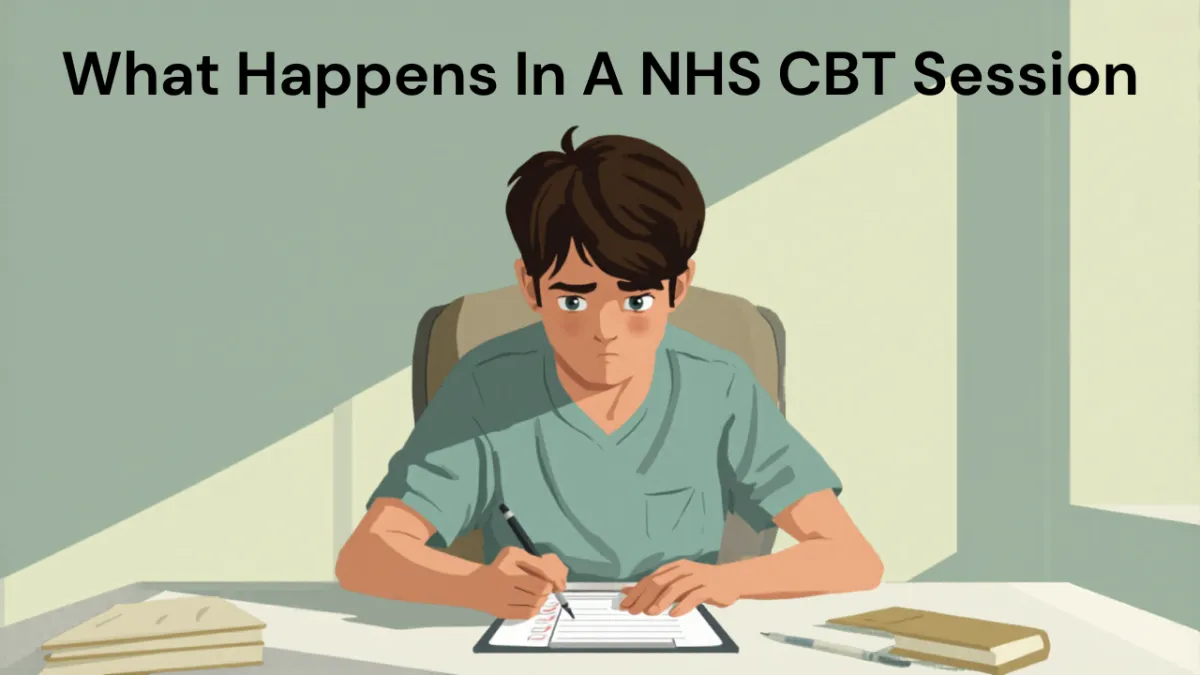
If you do reach individual CBT sessions, here is what a standard course looks like in practice.
Sessions typically last around 50 to 60 minutes and are delivered weekly or fortnightly. A standard course runs for 6 to 12 sessions, though this varies. The sessions are structured and goal-oriented rather than open-ended.
In the early sessions, the therapist will help you map out the connections between your thoughts, feelings, physical sensations, and behaviours. This is the core CBT model, the idea that anxious thoughts drive anxious feelings, which drive avoidant behaviours, which in turn reinforce the anxious thoughts.
From there, the work typically involves:
Identifying and challenging negative automatic thoughts
Keeping thought diaries and mood records between sessions
Behavioural experiments, testing out feared situations in a controlled way
Graded exposure to anxiety-provoking situations
Learning to recognise cognitive distortions such as catastrophising or black-and-white thinking
The homework element is significant. NHS CBT expects you to practise between sessions, filling in worksheets and completing exercises. This is not a passive process.
What CBT is Trying to Do
The underlying logic of CBT is sound in many respects. Anxious people do tend to have predictable patterns of distorted thinking. Avoidance does make anxiety worse over time. Learning to challenge unhelpful thoughts and gradually face feared situations has genuine evidence behind it.
For some people, particularly those with mild to moderate anxiety and a very specific, recent trigger, CBT produces meaningful results.
Where NHS CBT Falls Short
The problems tend to emerge for people with more complex, long-standing anxiety. And that is most of the people seeking NHS anxiety help.
It works top-down, not bottom-up. CBT engages the thinking mind. But anxiety is not primarily a thinking problem. It is a physiological response driven by the subconscious mind and the nervous system. Telling yourself a situation is not dangerous does not stop your body from responding as though it is. You can know, rationally, that a social situation is safe and still feel overwhelming anxiety in it. CBT does not change the subconscious patterns at the root of that response.
It talks about anxiety rather than resolving it. Sessions are largely analytical. You explore where the anxiety came from, what maintains it, and how your thoughts contribute to it. This can feel helpful in the room. But understanding your anxiety is not the same as being free from it. Most people finish CBT with greater insight but no practical tools for calming down in the moment when anxiety hits.
The session limit is a serious constraint. A 6 to 12 session cap is rarely enough time to meaningfully shift anxiety that has been present for years. Just as the work starts to go deeper, the course ends.
Guided self-help is not therapy. A large proportion of NHS anxiety referrals never reach face-to-face CBT at all. Workbooks are useful resources, but they are not a substitute for skilled, personalised support.
The wait makes things worse. Anxiety left untreated and unaddressed tends to deepen. Waiting months for help means many people arrive at their first appointment in a significantly worse state than when they were referred.
What Effective Anxiety Treatment Looks Like Instead
The key difference between CBT and more effective approaches is not the quality of the therapist; it is the level at which the work happens.
Approaches like clinical hypnotherapy, NLP, EMDR, and EFT work directly with the subconscious mind, where anxiety actually lives. Rather than analysing thought patterns, these methods update the underlying programmes that are generating the anxious response in the first place.
The result is not just a better understanding of anxiety. It is a genuine shift in how the nervous system responds to the triggers that used to cause problems.
Most people who take this route notice real change within 3 to 5 sessions. Not because it is a quick fix, but because it is working at the right level.
If you have been through NHS CBT and still feel stuck with your anxiety, you are not alone, and it is not your fault. The approach simply was not designed to reach the part of the mind where your anxiety is rooted.
Find out more about how we work with anxiety on our anxiety treatment Newcastle page, or download our free Anxiety Relief Pack to get some practical tools you can start using today.
Useful Anxiety Treatment & Therapy Blog Articles.
Why the NHS Keeps Failing People with Anxiety Disorders
Does Hypnotherapy Actually Work For Anxiety? Here's What The Science Says
Anxiety Treatment in Newcastle: Your Complete Guide to Getting Help
How a Newcastle Professional Became Anxiety-Free in 3 Weeks — Marie's Story
What Happens During Your First Hypnotherapy Session for Anxiety in Newcastle