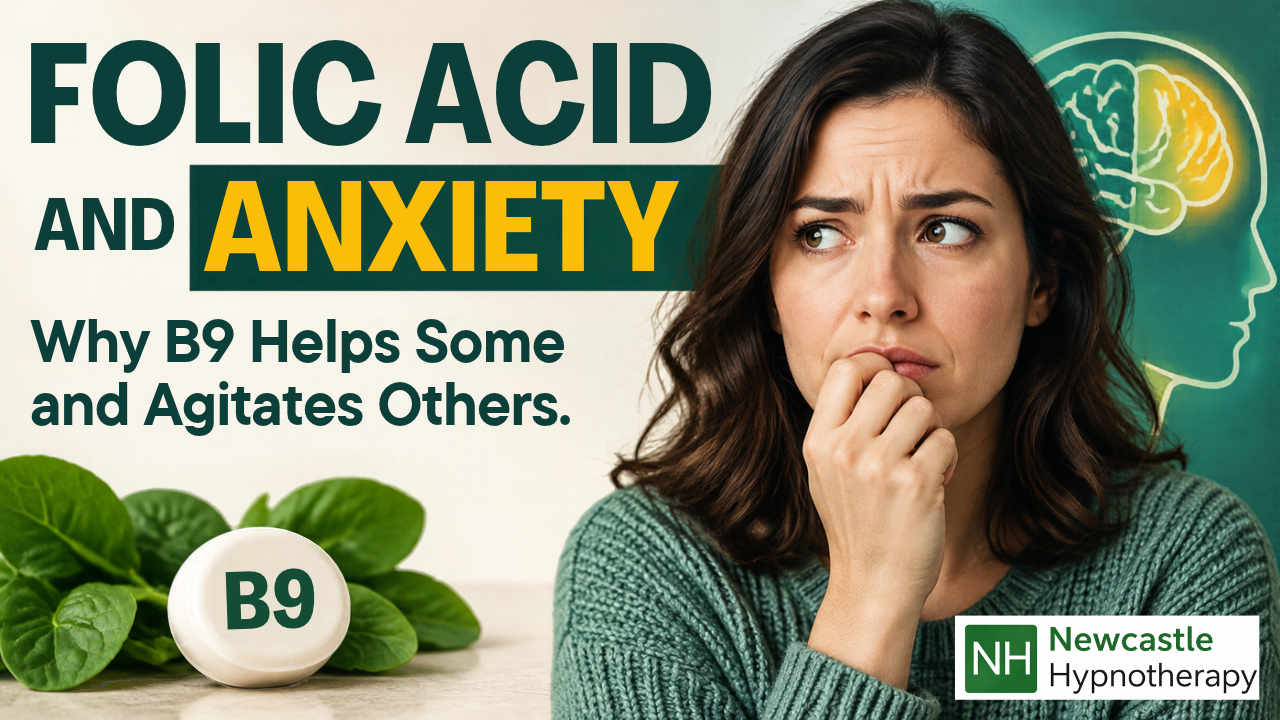
Folic Acid and Anxiety: Why B9 Helps Some and Agitates Others
Short answer: folic acid and anxiety have a more complicated relationship than most people are told. If your folate (vitamin B9) is low, that can contribute to anxiety, low mood and poor sleep. But for some people, the synthetic form of B9 called folic acid may not sit well with their body, and in my experience it can leave them feeling agitated, emotional or on edge. The difference comes down to the type of B9, how your body processes it, and how well you absorb nutrients in the first place.
I'm Mark Morley, a clinical hypnotherapist, qualified nutritional therapist and Master NLP practitioner, and owner of Newcastle Hypnotherapy, a specialist anxiety clinic in Gosforth. Here is what I have learned from more than ten years of working with anxiety clients, and from my own health journey.
Folate and folic acid: not the same thing
Both are called vitamin B9, which is where the confusion starts.
Folate is the natural form of B9. It is found in food, and the body is well designed to use it for many important processes.
Folic acid is a synthetic, man-made form. It is used in cheaper processed foods and in many dietary supplements.
Folic acid is absorbed a little more easily than natural folate, which is why it is so widely used. But many people struggle with it in a number of ways, and there are growing concerns about its safety for some people. Nutrition research is complicated, and studies often disagree, so I am not here to tell you that folic acid is dangerous for everyone. It isn't. My point is that one approach does not suit everybody.
Why B9 can help one person and agitate another
Everybody's body works differently, and the nutritional approach for one anxiety client is not the same as for the next.
When low folate drives anxiety
If your folate is low, this can be a trigger for anxiety, depression and other mental health difficulties. Restoring healthy levels can make a real difference. The catch is that low levels are not always caused by a poor diet. I will explain more about that below.
When folic acid may be the problem
Some people appear to have difficulty with synthetic folic acid. Clients in this group often describe feeling more anxious or stressed, sleeping badly, or being unusually emotional. You may have seen the claim that 43 percent of the UK population is genetically intolerant to folic acid. That figure is oversimplified. What the numbers really describe is how common it is to carry one copy of a common MTHFR gene variant, a gene involved in processing folate. Carrying one copy reduces enzyme efficiency a little, which is mild. A smaller group, around 10 percent of the UK population, inherit two copies, and in them enzyme activity can be reduced a great deal.
Genes are only part of the picture. Gut health, stress, diet and the supplements you take all play a part, which is why I look at the whole person rather than a single number.
A real example: when the tears wouldn't stop
One of my anxiety clients had done brilliantly. She practised her homework every day, and her anxiety and panic had fallen to better than normal. The one thing left was that she was overly emotional and often burst into tears for no reason.
Through testing, we found she was intolerant to folic acid. We worked together to improve her diet and avoid it completely. Within a couple of weeks her emotions had stabilised for the first time in years.
And the opposite: when the problem is absorption
Another client came to us with anxiety that had moved on to awful IBS symptoms. Her diet was very good, and she was taking expensive supplements. Her tests showed that despite eating the right foods and taking those supplements, her digestive system was not absorbing folate and several other key nutrients.
A few small tweaks to her diet improved her digestive health and resolved her IBS, and her anxiety quickly disappeared. For her, the answer was not more B9. It was making sure her body could actually take it in.
These two stories sit at opposite ends of the same issue, which is why there is no single fix for everyone.
Why I take nutrition so seriously
I started studying nutrition at 16, after the NHS talked about putting me on disability because of severe anxiety, depression, a stammer, IBS, asthma and other health issues. It took me two years on my own to resolve those problems, and I came off all my medication in the process (please do not stop any medication without speaking to your GP, as this was my own experience). I started a business as a DJ, later ran a health food business, and went on to qualify as a nutritional therapist. I am also a clinical hypnotherapist, Master NLP practitioner, Time Line Therapy practitioner and EFT practitioner.
Newcastle Hypnotherapy has won 8 consecutive awards for best hypnotherapy in Newcastle, and we have more than 100 five-star Google reviews. The reason is that we look at why anxiety is happening, not just how to cope with it.
How food and gut health affect anxiety
Food intolerances and sensitivities can cause inflammation in the gut and brain, which may reduce the production of serotonin, the natural chemical that helps regulate how we feel. Stress also affects the gut, and gut problems feed back into mood, so people can get stuck in a loop.
That is why we often test for gut microbiome, digestive health, vitamins, minerals and more. We then coach clients to gently improve their diet, remove foods that cause problems, and replace them with a wider range of foods. Sometimes supplements are needed to restore natural nutrient levels and gut health. Everything is tailored to the person.
What you can try if you suspect folic acid is a problem
Speak to your NHS GP first. It is the right starting point. In my experience, GPs often have little time to explore diet and anxiety unless symptoms are severe, so some people find a private practitioner is faster and goes deeper.
Check labels. Look for folic acid in fortified foods, processed cereals and breads, and in supplements. Labelling is not always clear, and not every practitioner understands the link between folic acid, diet and anxiety.
Eat natural folate. Green leafy vegetables are an excellent source. Some supplements contain natural folate rather than folic acid, so read the label carefully.
Give it time. If you remove foods with added folic acid, it can take a few months to notice the difference, and you should feel it as you add in better foods.
Consider testing. Testing can show what your body is actually doing with folate and other nutrients, rather than guessing.
Important: if you are pregnant or trying to conceive, or a doctor has prescribed folic acid for you, please speak to your GP or midwife before changing anything. This article is general information and not medical advice.
Who we see, and what it feels like
We see many busy professionals who have put everything into their careers and neglected their health, parents who put everyone else first, and NHS staff, including GPs and medical staff, working long stressful hours with little time for self-care. People with poor diets are also very typical clients.
It usually starts quietly: feeling a little uneasy during the day, the mind ruminating on "what if" thoughts, feeling sluggish and tired, and disturbed sleep. If it continues, time off work becomes common, and digestive problems such as IBS and reflux often join in. Most people try their GP first, then medication with side effects. Some join long waiting lists for CBT, counselling or talking therapies, and find these haven't worked by the time they find us.
How quickly can things change?
It varies from person to person, depending on the causes, how long it has been going on, and lifestyle and environment. Most of our clients notice their anxiety reduce significantly within one or two sessions as they follow their personalised plan and do their homework. Over four to six weeks, most find their anxiety has largely resolved as their confidence grows.
Frequently asked questions
Can folic acid make anxiety worse?
For some people it can. Others do well on it, and low folate can itself contribute to anxiety. That is why testing and a personalised approach matter more than a blanket rule.
What is the difference between folate and folic acid?
Folate is the natural form of vitamin B9 found in food. Folic acid is the synthetic form used in fortified foods and many supplements.
Should I stop taking folic acid?
Not without speaking to your GP, especially if you are pregnant, trying to conceive, or it was prescribed to you.
Can diet really affect anxiety?
In my experience, yes. Nutrient levels, gut health and food intolerances can all play a part in how anxious, tired or emotional you feel.
What is the MTHFR connection?
MTHFR is the name of a gene, and also of the enzyme that gene makes. Its job is to help your body turn folate into L-methylfolate, the active form of vitamin B9 that your cells actually use. That active form supports methylation, a process involved in making brain chemicals, managing stress and keeping homocysteine, a by-product of protein metabolism, at healthy levels.
Some people carry a common variation in this gene. The two most talked about are called C677T and A1298C. A variation can make the enzyme work less efficiently, so the body converts less folate into its active form.
This is where the often-quoted 43 percent figure comes from. Roughly a third to nearly half of people of European descent carry one copy of a variant. One copy slows the enzyme a little, and most people with it never notice a thing. A smaller group, around 10 percent, inherit two copies, and the enzyme can work much more slowly.
Why this matters for folic acid. The theory is that when the conversion pathway is slower, synthetic folic acid may not be processed as smoothly, and the unprocessed form can build up. Some practitioners believe this contributes to feeling wired, low, tearful or unable to sleep. I see it as one possible piece of the puzzle, not a diagnosis. Research in this area is still developing and studies do not always agree.
What I would not tell you. Having an MTHFR variant does not mean you will have anxiety, and it does not mean you must avoid folic acid. Your diet, gut health, stress levels and nutrient absorption all matter just as much. That is why I look at the whole person, not a single gene.
If you are curious, MTHFR testing is available privately, not through the NHS, and I would always want to read the result alongside your symptoms, diet and blood markers. Your GP can advise on whether anything needs checking.
Talking to someone who can help
If you are struggling with anxiety, digestive issues, IBS or anything else, please reach out. There are people who can help you. Many people avoid their GP because of the short appointments, the reliance on covering symptoms with another medication, or a lack of understanding of their problem.
Our aim is to help you explore exactly what is going on and why, and to see whether we can help you. If we can, we will go through your options and create a personalised plan that is right for you.
We offer you a free 30 minute assessment consultation call, with in-person sessions at our Gosforth clinic or online sessions. Visit Newcastle Hypnotherapy to book yours, and download our free anxiety relief pack to start feeling calmer today.
Related Reading
10 Questions to Ask Before Starting Anxiety Therapy in Newcastle
How to Fix Anxiety Fast: Your Top 21 Anxiety Questions Answered