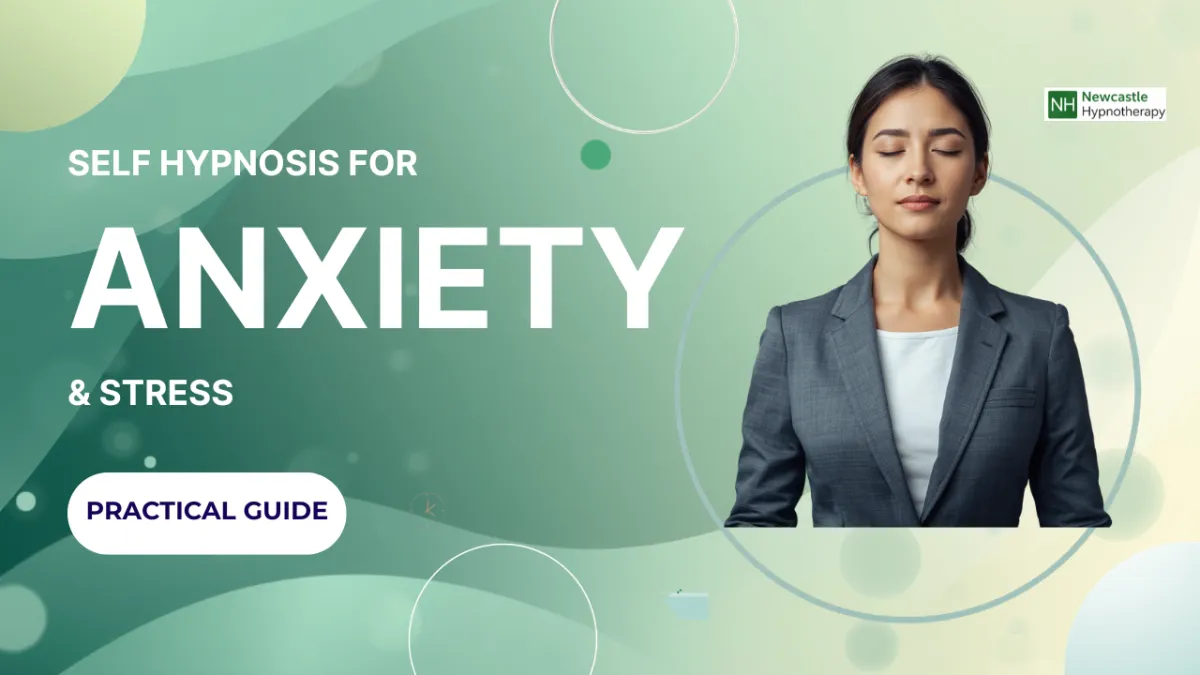
Self Hypnosis for Anxiety and Stress: A Practical Guide for Busy Professionals
For professionals in Newcastle and online
Anxiety and stress have become default settings for many professionals. Deadlines, demands, back-to-back meetings, the constant pull of notifications, and the quiet background hum of worry that follows you home. If that sounds familiar, you are not broken. But you do deserve better tools.
Self-hypnosis is one of the most underused and misunderstood tools available for managing anxiety and stress. In this article, we will explore what it actually is, what the research says, and how it can become a practical part of your daily life, whether you are based in Newcastle or working with us online.
The Self-hypnosis Workshop - Newcastle Hypnotherapy.
What is Self-Hypnosis?
Self-hypnosis is a guided process of focused relaxation and mental suggestion that you direct yourself through. It is not sleep. It is not losing control. And it is nothing like the stage hypnosis you might have seen on television. Instead, it is a deliberate, learnable skill that allows you to quieten the noise of a busy mind and communicate directly with the part of your brain that drives habitual thinking and emotional responses.
When you enter a hypnotic state, your brain shifts into a more receptive mode. The analytical, critical part of your mind steps back, and you become more open to positive suggestions and new perspectives. Done consistently, this rewires how you respond to stress triggers at a deeply subconscious level.
The Benefits of Self-Hypnosis for Anxiety and Stress
The evidence base for hypnosis as a tool for anxiety and stress management has grown significantly. Here are the core benefits that professionals using self-hypnosis regularly report.
Rapid Nervous System Regulation
Self-hypnosis activates the parasympathetic nervous system, your body's built-in brake pedal. Within minutes of beginning a session, heart rate slows, cortisol production decreases, and the body shifts out of its fight-or-flight response. For professionals dealing with high-pressure environments, this is not a luxury. It is a performance tool.
Breaking the Anxiety Thought Loop
Anxiety thrives on repetition. The same worries cycle round and round, and the more attention you give them, the stronger they become. Self-hypnosis interrupts this loop by giving the mind a different focus and installing calmer, more grounded thought patterns. Over time, the loop loses its grip entirely.
Better Quality Sleep
Anxiety and poor sleep are closely linked. The racing mind that keeps you awake at 2am is the same mind that self-hypnosis trains you to calm on demand. Many clients report significant improvements in sleep quality within weeks of beginning a regular practice.
Reduced Physical Symptoms of Stress
Stress is not just a mental experience. It lives in the body as tension headaches, a tight chest, shallow breathing, digestive issues, and fatigue. Self-hypnosis works at the physiological level to release stored tension and retrain the body's default stress response.
Increased Focus and Mental Clarity
Anxiety consumes bandwidth. When your nervous system is constantly on alert, there is less cognitive resource available for clear thinking, decision-making, and creativity. Regular self-hypnosis practice frees up that bandwidth, and many professionals notice sharper focus and better performance at work as a direct result.
A Tool You Own Forever
Unlike medication or therapy that requires ongoing access, self-hypnosis is a skill. Once you have learned it, you have it. You can use it in a car park before a difficult meeting, on a train, during a lunch break, or last thing at night. It is portable, free, and always available.
What Does the Research Say?
Hypnosis and self-hypnosis are not fringe concepts. The American Psychological Association recognises hypnotherapy as a legitimate clinical tool. Research published in peer-reviewed journals consistently shows meaningful reductions in anxiety, stress, and related symptoms following hypnotic interventions. A meta-analysis of 18 studies found hypnosis to be more effective than relaxation training alone for anxiety. Brain imaging studies also show measurable changes in how hypnotised subjects process information and regulate emotional responses.
Self-Hypnosis as Part of Our Anxiety Elimination Treatment
At our practice, self-hypnosis is not an add-on. It is a core component of our anxiety elimination treatment programme, designed specifically for professionals who are ready to stop managing their anxiety and start removing it.
Our programme combines evidence-based hypnotherapy with practical self-hypnosis training, so that you leave every session with techniques you can use immediately. The goal is not dependency on a therapist. The goal is independence and permanent change.
We work with professionals in Newcastle face-to-face, and with clients across the UK and internationally via our online programme. The results are consistent: when people engage fully with the process, including the self-hypnosis practice between sessions, anxiety levels drop significantly, and the changes stick.
How to Get Started with Self-Hypnosis
While a full self-hypnosis practice is best learned properly, here is the basic framework to give you a sense of what the process involves.
Find a quiet space. Sit or lie comfortably where you will not be disturbed for 10 to 20 minutes.
Focus your attention. Close your eyes and bring your awareness to your breathing.
Slow your breathing. Breathe in for four counts, hold for two, out for six. Repeat until your body begins to settle.
Deepen the state. Mentally count down from ten to one, imagining with each number that you are sinking deeper into comfortable relaxation.
Apply your suggestion. Repeat a calm, positive statement in the present tense. "I am calm and in control." "I handle pressure with ease." Keep it simple and personal.
Return gently. Count back up from one to five, bringing your awareness back to the room, feeling refreshed and grounded.
This is a starting point. With proper training, the depth, precision, and results you can achieve are significantly greater.
Join One of Our Self-Hypnosis Events
If you want to learn self-hypnosis properly, in a supported and practical setting, we run regular self-hypnosis workshops and events for professionals. These sessions give you hands-on experience of the techniques, the chance to ask questions, and a foundation you can build on independently.
Events are held in Newcastle and are also available to join online, so wherever you are based, there is an option that works for you.
Ready to Take the First Step?
Whether you are curious about self-hypnosis, interested in our next event, or ready to explore what our anxiety elimination treatment can do for you, we would love to hear from you.
Enter your details here, and we will let you know about our next event.
The Takeaway
Anxiety and stress are not signs of weakness, and they are not something you simply have to live with. Self-hypnosis is a practical, evidence-backed skill that puts the control back in your hands. When learned properly and practised consistently, it genuinely changes how your mind and body respond to pressure.
As part of our wider anxiety elimination treatment, it forms one of the most powerful elements of lasting recovery. If you are a professional in Newcastle or working with us online, we are here to help you get there.
https://www.newcastle-hypnotherapy.com/anxiety-treatment-newcastle
How Long Does Anxiety Therapy Take in Newcastle? Realistic Timelines Explained
Affordable Anxiety Therapy Options in Newcastle