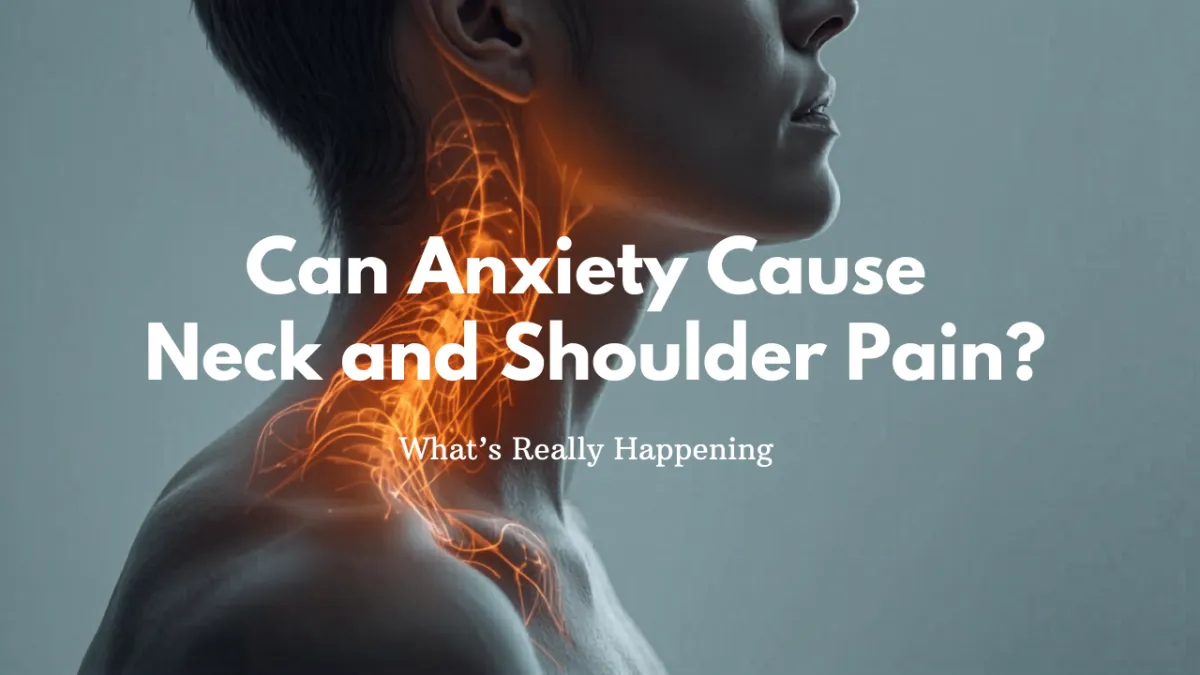
Can Anxiety Cause Neck and Shoulder Pain? What’s Really Happening
If you spend your days hunched over a laptop and your nights dealing with a stiff neck or "knots" in your shoulders, you might blame your desk chair. While ergonomics matter, for many high performers, the real culprit is a chronic state of emotional hyper-vigilance.
The connection between your mind and your Trapezius muscles is one of the fastest communication lines in the human body. To fix the pain, you have to understand the "Survival Architecture" behind it.
Is your anxiety causing your neck and shoulder pain? Our award-winning anxiety therapy can help you in Newcastle and online.
The "Turtle Response"
When your brain perceives a threat, whether it is a predatory animal or a passive-aggressive email from a client, it initiates a "Startle Response." This causes the shoulders to shrug upward and the neck to shorten.
In biology, this is designed to protect the vulnerable carotid arteries and the cervical spine from injury. In the modern world, where stress is constant, this "Turtle Response" never fully releases. Your muscles stay in a state of semi-contraction for hours or days, leading to decreased blood flow, lactic acid buildup, and chronic pain.
The Feedback Loop of Fear
The tragedy of anxiety-driven physical pain is that the pain itself becomes a new source of anxiety. Your brain senses the tension in your shoulders and interprets it as a signal that you are still in danger. This keeps your cortisol levels high, which in turn keeps the muscles tight.
Traditional massage or physiotherapy can offer temporary relief, but if the "Threat Detection" software in your brain is still running, the muscles will simply tighten up again within 48 hours.
Looking for the fastest anxiety treatment in Newcastle?
How to Break the Physical Tension Loop
To achieve lasting relief, you must address the neurological signal and the biological environment of the muscle.
1. NLP and the "Safety Signal"
Using Neuro-Linguistic Programming (NLP), we identify the specific mental triggers that cause your shoulders to "hit your ears." We then install a new neurological anchor. This allows you to consciously and subconsciously "drop" the tension the moment it starts, breaking the habit before it becomes a knot.
2. Clinical Hypnotherapy
Hypnosis is the most effective way to communicate with the Autonomic Nervous System. While you are in a state of deep relaxation, we can "reset" the baseline tension of your upper body. We teach your nervous system that it is safe to move out of the "Sympathetic" (Fight or Flight) state and into the "Parasympathetic" (Rest and Digest) state.
3. Nutritional Support for Muscle Recovery
Chronic stress depletes the very minerals required for muscle relaxation. Magnesium and Potassium act as the chemical "off-switch" for muscle fibres. If you are deficient, your muscles physically cannot let go. By addressing these gaps through Nutritional Therapy, we give your body the tools it needs to stay soft and flexible even during a busy workday.
Put Down the Weight of the World.
If your neck and shoulders are screaming for a break, stop ignoring the signal. A massage might help for an hour, but our integrated approach helps for a lifetime.
Newcastle Hypnotherapy's Anxiety Treatment is the fastest way to help your neck and shoulders feel better. https://www.newcastle-hypnotherapy.com/anxiety-treatment-newcastle
Your next anxiety articles:
Overcoming Anxiety, Panic Attacks & Trauma: Rob's Story
Newcastle Hypnotherapy: Newcastle's Highest-Rated Anxiety Therapy Clinic
How to Get Rid of Severe Anxiety: Why a Specialist Gets Results in Weeks, Not Months